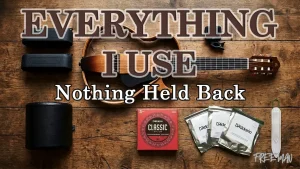

Nothing here is held back. Here’s every piece of gear I actually use for silent guitar and classical guitar.
This is gear I’ve refined over years of using a silent guitar — and naturally, it applies just as much to anyone playing classical guitar.
Showing You What I Actually Use Is the Most Honest Way to Do This
This article lays out exactly what I personally use for practicing, playing, and creating on silent guitar and classical guitar. Before recommending anything, I think the most honest approach is showing you what I actually reach for.
Take this as a real user’s field notes.
I’ll be upfront about what works well and what I wish were better.
My Main Instruments

Silent Guitar: The Yamaha SLG200NW
This is the core of my day-to-day practice and playing.
Playing at low volume through a speaker is how I use it most.
Thanks to the mic simulator, playing through headphones has become genuinely usable whenever the situation calls for it.
Late at night especially, playing a little in a dimly lit room before bed gives me something close to the effect of listening to relaxing music.
- EQ controls that let me adjust tone to the situation
- Light enough to carry around easily
- Playable pretty much anywhere
These are its major practical strengths.
Using headphones on their own has become genuinely practical thanks to the mic simulator improvements, but compared to the spatial sound you get through a speaker, there’s still a gap in how much tone control feels like a real classical guitar. I want to be straightforward about that.
Speaker-based playing as my main approach, headphones for whenever the situation calls for them — that’s my answer, at least for now.
Classical Guitar (Acoustic, Unplugged)
- How the sound is produced
- The feel of your touch
- How the sound fills the space
When I have the time and an environment where I can actually make noise, and I feel like playing, I reach for the acoustic classical guitar.
Confirming, on the real acoustic instrument, technique I’ve built up practicing on the silent guitar is a genuinely important step for raising the quality of my playing.
All three feel noticeably different from the silent guitar. Switching between the two lets me cover both quantity and quality of practice.
Accessories and Consumables
The Speaker I Use With My Silent Guitar (Just My Take)
I use this to send the silent guitar’s sound out into open air.
You don’t need a large speaker. I go with something small that still delivers decent sound quality, and adjust the volume to fit the situation.
Playing through a speaker is what actually brings back that classical-guitar playing feel.
That’s the biggest difference from headphones. A speaker is essential gear for getting the real appeal of a silent guitar out of it.
I personally run two of a low-latency speaker model. They’re cheap enough that buying a pair is genuinely reasonable.
Pair them together and you get a fuller sound, or set them up in two different spots and you get an environment where you can start playing the moment you walk into either room.
A Tuner That Works Well With a Silent Guitar
I use a clip-on chromatic tuner.
Clipped onto the headstock, it minimizes the hassle of tuning.
Getting tuned up in under 30 seconds before practice lowers the barrier to actually starting.
The silent guitar (SLG200NW) also has a built-in tuner, and whenever that’s convenient to use, I use that instead.
String Replacement and Care
Strings are a consumable, and replacing them regularly is directly tied to maintaining good tone.
String lifespan depends on how much you play and the humidity of your environment, but here are the two signs it’s time to swap them:
- The brightness of the tone starts to fade
- Visible corrosion shows up
Put off replacing strings, and you get used to the degraded tone, which makes it harder to actually feel like you’re improving.
Checking string condition regularly is an important habit for maintaining playing quality.
The more you play, the more often you’ll need to replace strings, and the cost adds up over time. I’d recommend going with strings that keep quality reliable while keeping the per-set price reasonable.
Nail Care Tools
On classical guitar, your right-hand nails have a direct effect on tone.
Nail length and shape determine how much richness you can actually pull out of the strings.
- A nail file
- A nail buffer
- A nail-protecting coating
These are low-cost tools that lead to a genuinely noticeable improvement in tone.
From years of playing, I want to say plainly: nail care matters just as much as technique in classical guitar playing.
I explain nail care in detail.
Please use automatic translation for Japanese articles.
A Guitar Cushion (Dynarette-Style Support)
When I play the acoustic guitar, instead of a footstool, I use a cushioned guitar support that rests on my lap (a Dynarette-style cushion).
Because I don’t have to prop my left leg up awkwardly, I can keep my posture straight and keep physical strain to a minimum.
An environment where the right position is set the instant you sit down, with zero setup time, removes the small “ugh, setting up is a hassle” resistance to starting practice. It frees up your body and lets you put all your resources into the playing itself.
I explain the use of a footstool in detail.
Please use automatic translation for Japanese articles.
About the Original Product I Built for Solo Guitar Progress
From the experience and the problems I’ve laid out across this series, I’ve built an original product of my own.
It’s designed by someone who deeply understands the player’s side of things, built from the player’s perspective.
It’s built with one goal: giving everyone who plays silent guitar or classical guitar a better experience. Simply knowing it exists is the first step.
Get a free PDF practice blueprint that works in 15 minutes a day — your entry point into a guitar method built from the ground up.
Just your email address — unsubscribe anytime.
How I Think About Silent Guitar Gear
Gear is a means to an end.
Sticking with what you already have is worth more than owning the best gear on the market.
That said, when your gear is actually the thing getting in the way of sticking with it, changing the gear is the fastest fix.
- Can’t play because of the noise problem
- Can’t keep going because of finger pain
These are problems a change in gear can genuinely solve.
Don’t obsess over gear — but the moment gear is actually the problem, change it without hesitating. That’s the right relationship to have with your gear if you want to stick with this long-term.
The Takeaway: Now You’ve Seen Everything I Use
What I actually use is more practical than expensive.
I only keep things around that directly contribute to sticking with practice. I’ve told you what works and what doesn’t, honestly.
For anyone out there looking for a silent guitar: that instrument isn’t just a quiet, practice-only guitar.
A silent classical guitar can be a genuine solo instrument, capable of expressing who you are, anytime, anywhere, for the rest of your life.