You can’t see the real cost of a Silent Guitar by looking at the price tag alone.
Lessons, soundproofing — there’s a lot that isn’t captured by the price of the guitar alone.
Like a house or a car, there are real ongoing costs starting the day you buy it. Let’s think this through properly.
The Guitar’s Price Tag Is Only Part of the Real Cost
Some people have the impression that “silent guitars are expensive.”
But that judgment often comes from comparing against the wrong thing. Compare instrument price alone, and you never see the total cost of actually sticking with guitar.
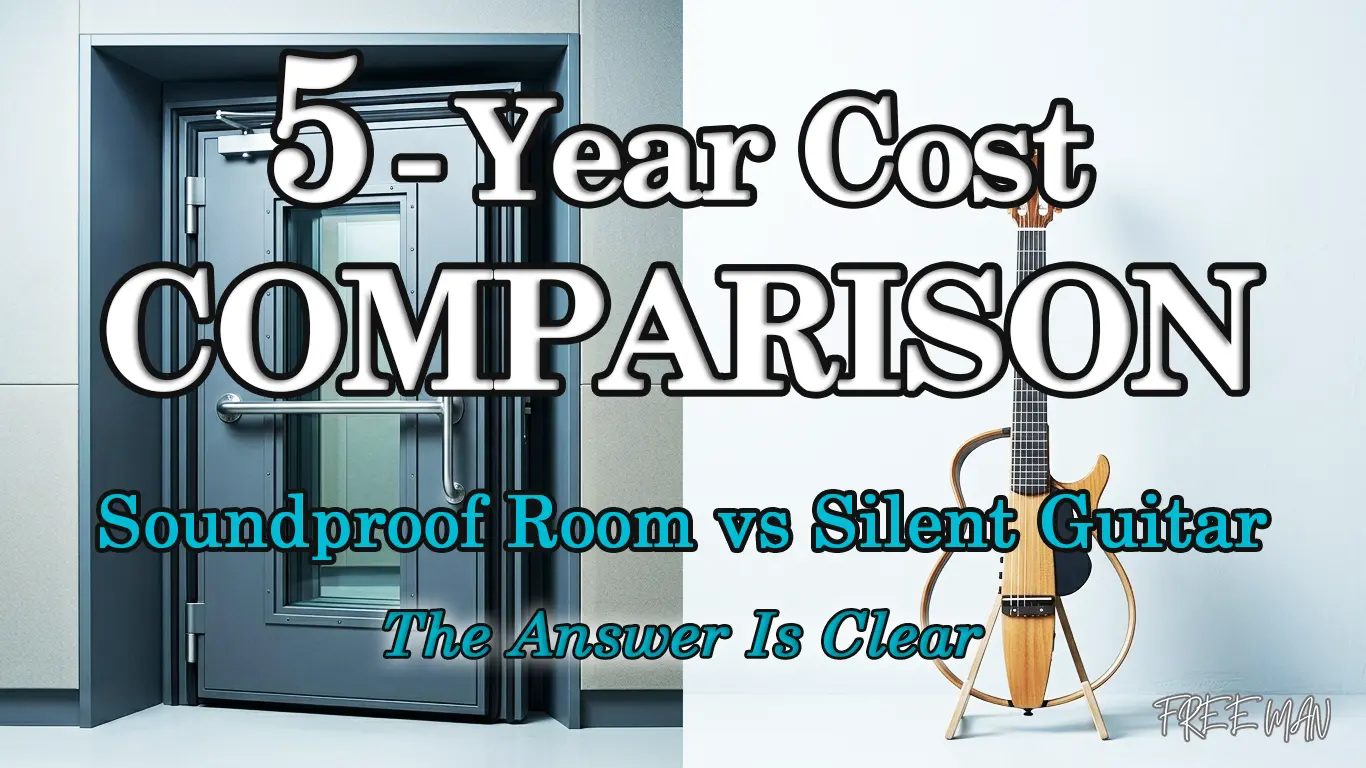
This article gives an honest, side-by-side comparison of the total cost of guitar lessons, a soundproof room, and a silent classical guitar, over a 5-year horizon.
Before diving into the comparison, one clarification: this isn’t an argument against taking lessons or owning a soundproof room. Each has real, distinct value.
That said, for:
- People who want to build an environment for teaching themselves
- People who want a fully self-contained solo experience
seeing the full cost picture accurately leads directly to a better decision.
The Cost of Taking Guitar Lessons
What Monthly and Annual Tuition Actually Looks Like
Private guitar lessons, once a week for 30 minutes, typically run around $150–$200 a month. That’s roughly $1,800–$2,400 a year. Over 3 years, that’s $5,400–$7,200. Over 5 years, $9,000–$12,000.
Beyond tuition, there are often added costs — method books, instrument maintenance, recital fees.
Of course, learning under a genuinely good teacher offers real value you simply can’t get on your own.
I can speak to this from personal experience.
A great teacher is genuinely great — there’s more to learn from one than you can count, and the impact carries into the rest of your life.
Catching and correcting technical mistakes early, and having outside accountability that helps sustain motivation — these are legitimate reasons lessons have real value. That said, if the actual goal is “being able to play guitar” rather than “attending lessons” as an end in itself, it’s also true that this cost doesn’t have to be the only path there.
Calculating the Time Cost
Round-trip travel time to a lesson, depending on location, typically runs 30–60 minutes for a weekly session — roughly 26–52 hours a year. Over 5 years, that’s 130–260 hours.
If that time went straight into practice instead, the technical impact wouldn’t be trivial. You don’t necessarily need to convert time into a dollar figure, but time is finite, and there’s a real opportunity cost to how you spend it.
The Cost of a Soundproof Room for Guitar Practice
The Real Upfront Cost
- A prefab, assembled practice booth: roughly $3,000–$12,000
- Full custom soundproofing construction: $10,000–$30,000+
These are upfront costs, and some setups add ongoing maintenance and utility costs on top.
Construction usually isn’t even permitted in a lot of rented apartments, and even a prefab booth eats into your room’s usable floor space. Moving apartments later means removal and disposal costs on top of everything else.
What a Soundproof Room Doesn’t Solve
A soundproof room doesn’t solve finger pain.
The instrument-choice problem is still unsolved. Building a practice habit remains a separate problem entirely, one soundproofing has nothing to do with.
Even after spending real money solving the noise problem, the risk of quitting for other reasons is still fully intact. A soundproof room solves the noise problem — it doesn’t solve the consistency problem. That distinction needs to be part of the cost decision.
Get a free PDF practice blueprint that builds consistency into the system — works in 15 minutes a day.
Just your email address — unsubscribe anytime.
The Cost of Choosing a Silent Classical Guitar
Upfront Cost and What It Actually Solves
- A Yamaha silent classical guitar: roughly $1,000
- A compact speaker: around $50–$100 (the one I personally use cost well under that)
- Consumables like strings: roughly $20–$40 a year
That’s the entire required cost picture.
This combination simultaneously solves the noise problem, the finger pain problem, the constraint on practicing at night, and portability. No construction needed, no lessons required (though this varies person to person), zero commute time. Keep using the same instrument long-term, and you never incur replacement costs either.
Total Cost Over 5 Years, Side by Side
- Guitar lessons (weekly, 5 years): $9,000–$12,000
- A prefab soundproof booth: $3,000–$12,000
- A silent classical guitar: roughly $1,000 upfront, minimal additional cost after that
Lay the numbers side by side, and the cost gap is unmistakable.
Looking at total cost over 5 years, a silent classical guitar comes out ahead on cost-effectiveness in the vast majority of cases.
The Value of Guitar Lessons Beyond the Cost
Direct instruction from a real guitar teacher carries value you can’t reduce to a number.
- Having your technical mistakes pointed out objectively
- Real conversation about musical expression
- Ongoing support for motivation
These are hard to get through self-teaching alone. A cost comparison is one piece of your decision — not the only standard that matters.
What matters is choosing with a clear, honest picture of both the experience you actually want and what it costs to get there.
- “It was cheap, so why not”
- “Everyone around me does it this way”
Choosing for reasons like these is what tends to produce regret.
Seeing the full cost picture and then choosing what actually fits you is what leads to a decision you won’t regret.
The Takeaway: Consider the Total Cost of a Silent Guitar
Choosing an instrument is also, inevitably, a cost question.
An option that looks expensive if you only look at the price tag can turn out to be the cheapest once you factor in total cost.
Today, run an honest calculation of the total cost you’re actually about to put into guitar. That calculation is the first step toward a choice you won’t regret.