When a beginner chooses classical guitar pieces, what matters most isn’t “what to play” but “in what order.”
Most beginners pick pieces that look easy or famous. But lining pieces up that way rarely builds technique.
In this article, I’ll share how to choose classical guitar pieces as a beginner, and give you an overview of the 30-piece roadmap I designed over 30 years of playing.
Order Decides Your Beginner Pieces
Difficulty Order Doesn’t Build Technique
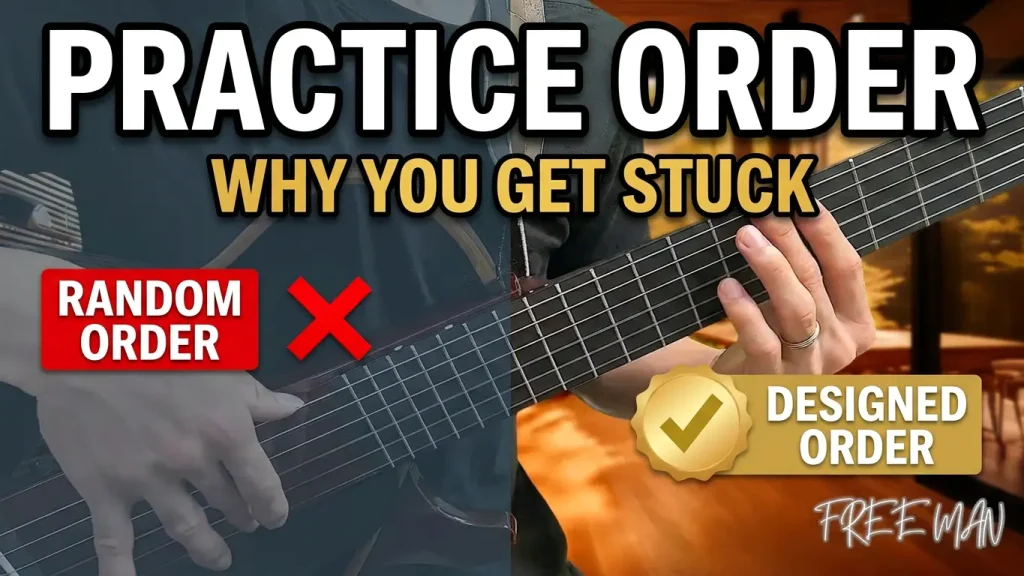
Many practice pieces are arranged by difficulty: easy ones first, harder ones later. At first glance, that makes sense. And jumping straight to difficult pieces is unrealistic anyway.
But that’s an order of playability, not an order for building skill. You can follow it and still move on with an unready right hand.
Each Piece Prepares the Next
After 30 years, the principle I arrived at is simple.
What you learn in one piece must be the prerequisite for the next.
Think of a computer: installing apps before the OS. It may run, but it will turn unstable somewhere. The classical guitar right hand has the same rule: build the foundation OS first.
Many people who stall are practicing the wrong pieces in the wrong order. It isn’t a talent problem. It’s a design problem. Practice in the right order, and you move forward steadily. In the wrong order, you hit the same wall again and again, however hard you work.
I’ve thought about this order for a long time:
- Which skill comes first
- Which piece is the prerequisite for the next
- Which practice suddenly pays off later
The result is the 30-piece map at Freeman 365 Studio.
How to Choose Your First Piece
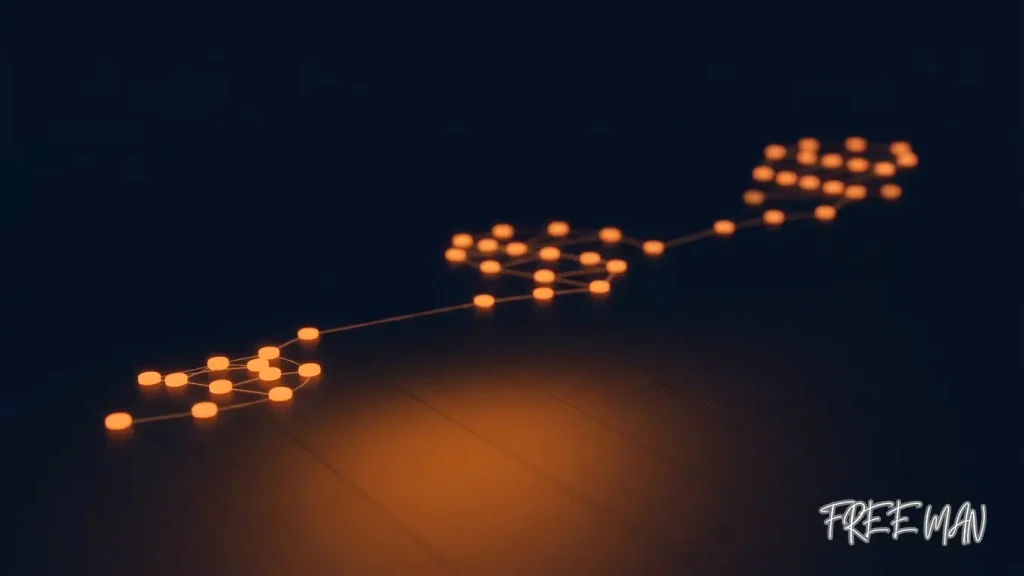
Rather than titles, here are the criteria for choosing a first piece.
1. One Clear Purpose
Pick a piece that trains one thing at a time, such as the thumb (p) alone, or one pair of fingers. Keep the purpose as simple as you can.
2. A Repeating Motion
A piece where p, i and m follow the same pattern makes finger coordination easier to learn. Because the pattern carries the whole piece, you finish a piece and build technique at once, with your attention on the fingers.
3. A Tempo You Can Control
Before speed, make every note even. Play at a tempo you control, without tension, and without stopping or falling apart midway.
For each right-hand finger’s role and exercises, see Classical Guitar Right Hand: Practice p-i-m-a Separately.

Why 30 Pieces in Three Phases

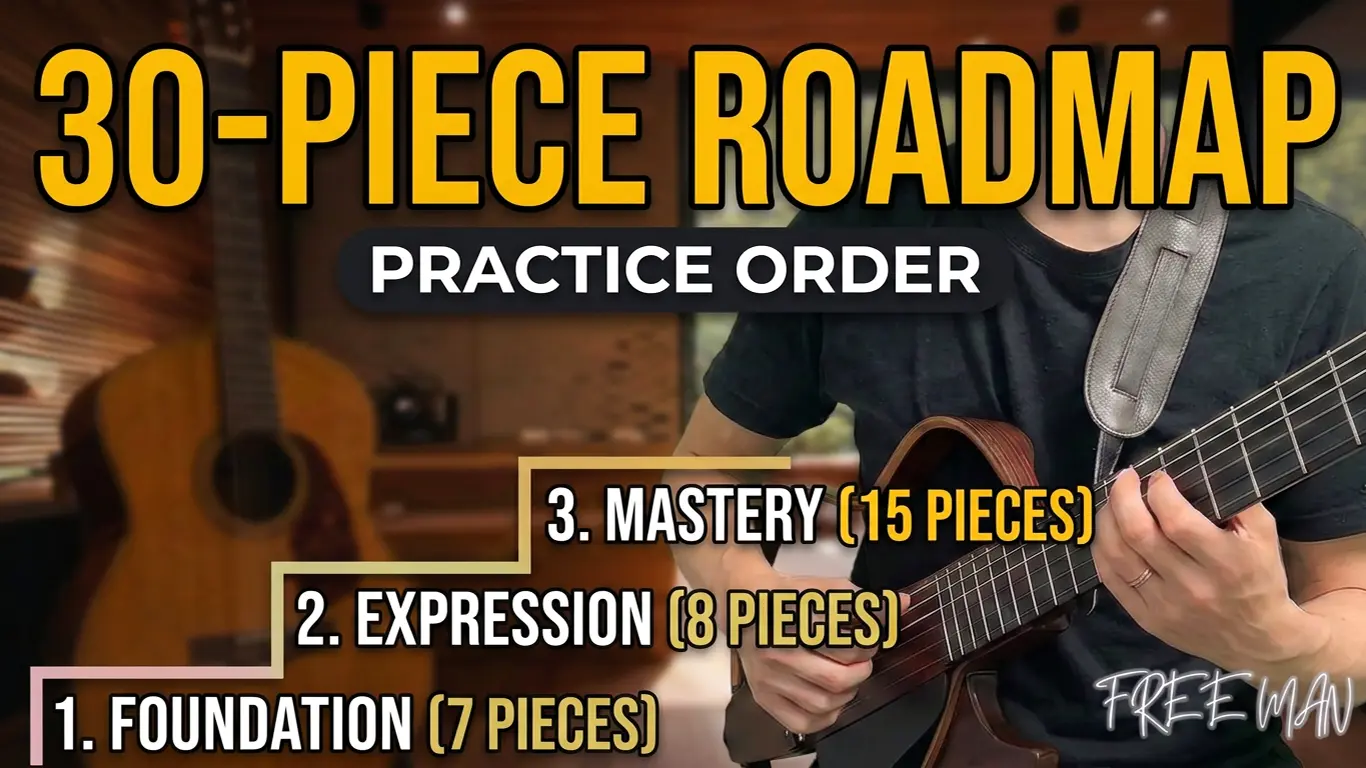
Freeman 365 Studio’s practice blueprint splits the 30 pieces into three phases. Every piece has a clear role, and the order has a reason.
Phase 1: Right-Hand Foundation (7 Pieces, Ume Plan)
The first seven pieces are dedicated to building your right-hand foundation, the OS.
- Thumb (p) focus
Build thumb independence, command of the bass strings, and the choice between apoyando and tirando. - Middle finger (m) focus
Develop an independent m and a soothing melody line played with apoyando. - Ring finger (a) focus
Train an independent a through melody lines that suit this hard-to-isolate finger.
With an integrating piece included, finishing these seven leaves all four fingers independent. You’re ready to think about the music, not your fingers.
This is the Ume Plan. Moving ahead without a right-hand OS is like building on sand.
Phase 2: Musical Expression (8 Pieces, Take Plan)
The next eight pieces are where technique becomes music.
- Scale focus
Put the flow of notes across the whole fretboard into your body. - Melody focus
Train deliberate right-hand control to make the melody stand out. - Tempo focus
Learn to move beyond the metronome and shape tempo musically.
After this phase, listeners stop saying “skilled” and start saying “musical.” Technique and musicality come together.
This is the Take Plan.
Phase 3: Concert Level (15 Pieces, Matsu Plan)
The Matsu Plan, with its remaining 15 pieces, builds concert-level playing.
- Tremolo focus
Make a, m, i and p fully independent in fast repetition. It’s among the hardest skills in classical guitar. - Polyphony focus
Create several voices sounding independently at once. - Applied pieces for tremolo, melody, rhythm, tempo and scales
Each piece targets one purpose, because that’s the design needed to master each key skill.
When you play these pieces well, your right hand barely crosses your mind. You’re thinking about:
- The music itself
- The breath of each phrase
- Changes in tone
That is the goal, and the end of the 30-piece map.
What the Matsu Plan Includes
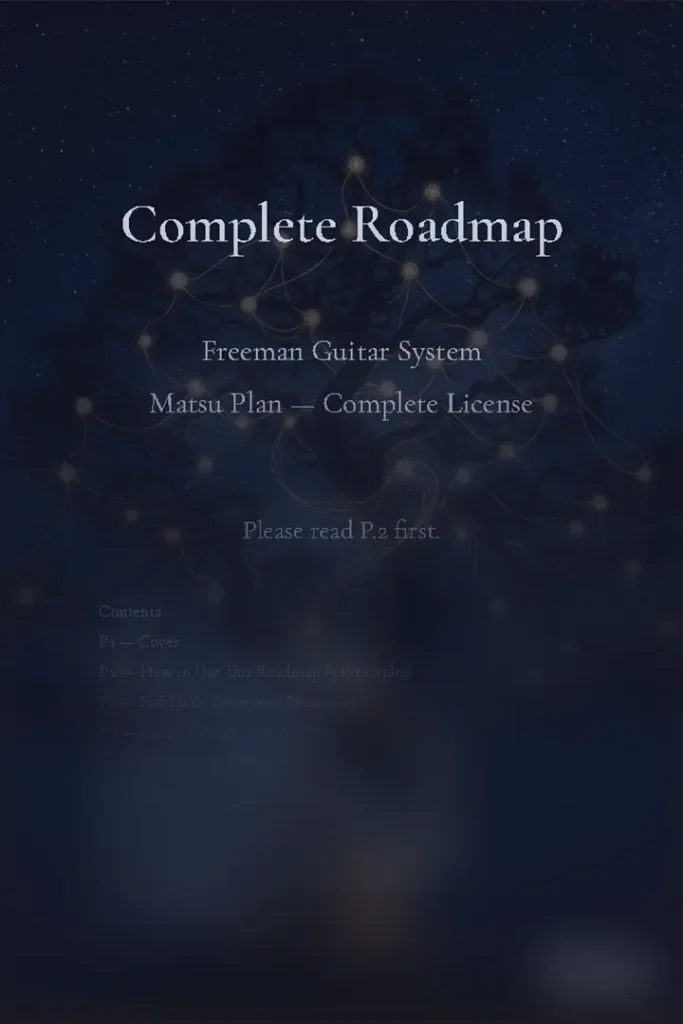
30 Pieces and the Complete Roadmap
The Matsu Plan includes the scores for all 30 pieces and a complete roadmap.
- What is the complete roadmap?
-
- The role of each piece
- The intent of the practice
- The technical skill each piece builds
- How each piece connects to the next
It’s a design document. Beyond the scores, it explains why you’re practicing each piece now.
As a map, the scores are the terrain and the roadmap is the route. Having both helps you reach the destination by the shortest path.
Single Pieces vs. the Full Plan
You can also get my blueprints one piece at a time.
The Matsu Plan gives you all 30 together, with the roadmap. It’s set up to be far better value than collecting 30 single pieces, and the roadmap isn’t available with individual purchases.
With the roadmap, the 30-piece map is complete.
Who the 30-Piece Roadmap Suits
Here’s an honest look at who the Matsu Plan fits.
For Those Who Play Alone, for Years
This blueprint is built to bring out the most joy in guitar through the pieces, to lead you to progress by the most efficient path, and to suit anyone who wants to play alone, quietly, for the long run.
No recitals. No judgment. Just a steady sense that you’re improving while you enjoy playing. This map is for you.
It also suits people short on time. It’s designed around three 15-minute sessions a week, so busy players can move at their own pace.
How to Get It
Sign up with your email and the free 15-minute blueprint, the base of your practice, arrives right away. Over the following days, I’ll send details and special pricing for the full lineup, including the Matsu Plan.
There’s no rush. Read it through and decide whether it fits you.
Players with a map and players without one end up in different places after the same practice time. Neither is “right.” But with a map, you know where you are and where to go next. That’s all it is.
Classical Guitar Pieces for Beginners: FAQ
Where should a beginner start?
I recommend starting by building your right-hand foundation. Choose pieces with one simple purpose, and it’s easier to see what you’re learning.
How many pieces do I need before I improve?
I believe order and purpose matter more than the number of pieces. Progress varies from person to person, so I can’t promise a timeline.
Can I arrange the order myself?
Yes. Start by checking whether what you learn in one piece is a prerequisite for the next. For how to structure your practice time, see How to Design a 15-Minute Guitar Practice.
Summary: Design the Order
For beginner classical guitar pieces, order changes results more than the pieces themselves. When each piece prepares the next, you keep moving forward.
Start with the free 15-minute blueprint, your practice map. Freeman 365 Studio offers three plans: Matsu, Take and Ume. The Matsu Plan is the one with all 30 pieces and the complete roadmap. You’ll get the details after you sign up for free.