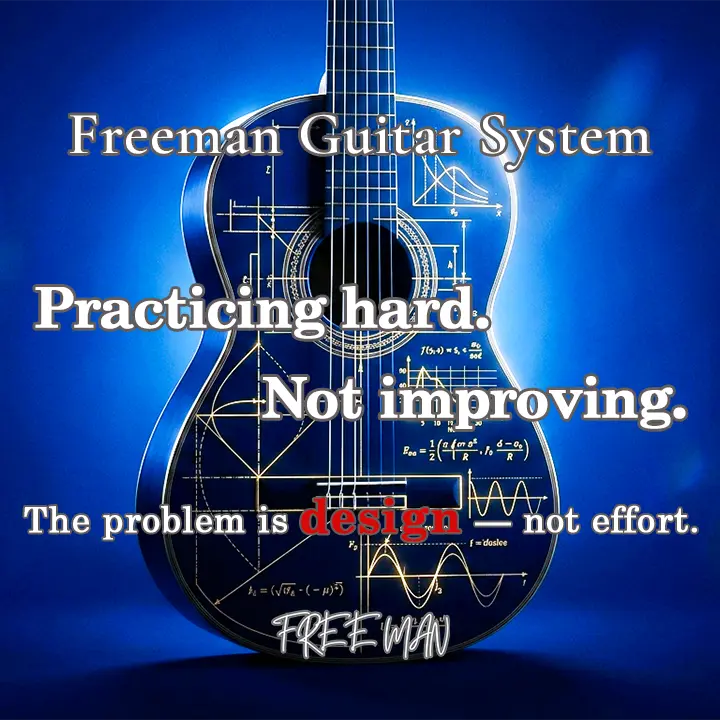
What decides your progress on guitar isn’t what you play, but the order you practice in. Practicing from sheet music alone is like building without a blueprint.
You practice, but you don’t feel yourself improving. You can play more pieces, yet something is missing. The cause may not be talent or practice time. It may be your guitar practice order.
This article explains why sheet music isn’t a blueprint for practice, and how to design your practice order.
Practice Order Decides Your Progress
Most people practice guitar from sheet music.
You read the notes and play them as written. You repeat the hard parts, and once you can play them, you move to the next piece. That’s the usual routine.
But that’s a way of using sheet music. It isn’t a practice design.
Sheet Music Only Tells You What to Play
Sheet music gives you pitch, length, dynamics and tempo. That’s performance information, not practice information.
- Why play this piece now?
- What should you learn before it?
- Where should you go once you’ve mastered it?
It might say “play this note for this long.” It never says “train this finger movement first so you can play this note.”
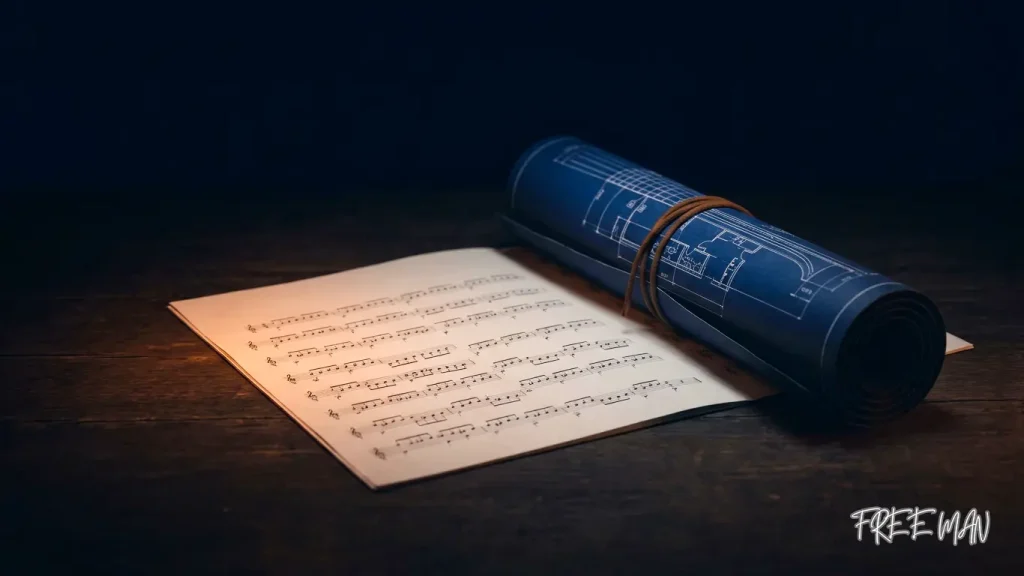
Sheet music is a blueprint for performance, not for practice. If you don’t see the difference, you can learn to play the notes as written while your technique never really builds up.
When, Why and in What Order
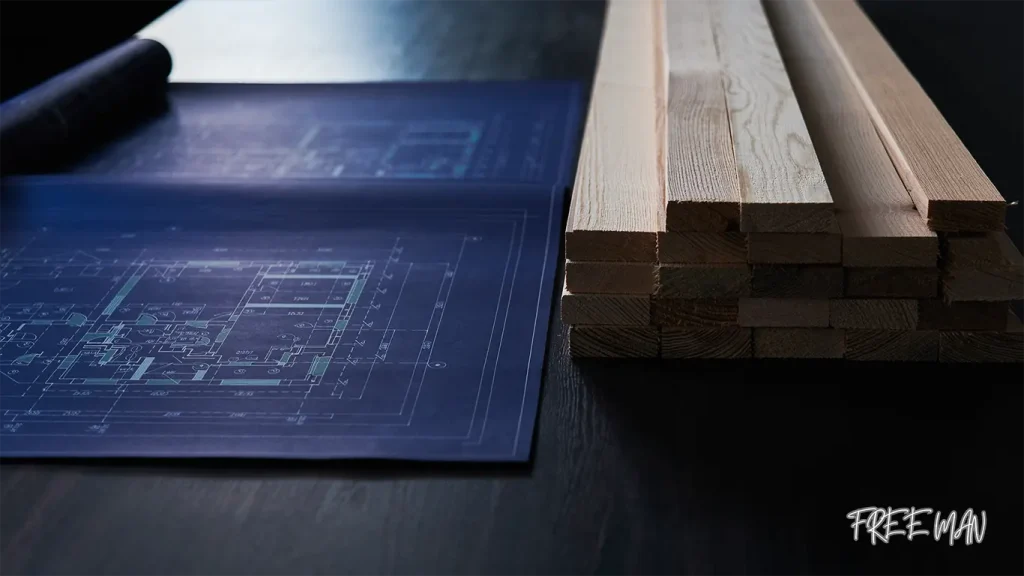
Think of building a house. Sheet music is the list of materials. A blueprint is the build instructions. With materials alone and no instructions, no house gets built.
It’s the same on guitar. If you practice complex arpeggio patterns before your right-hand thumb is independent, you stack advanced skills on a missing foundation. It’s like building on sand.
A practice blueprint shows not performance information, but the order in which skills are built.
Common Guitar Practice Order Mistakes
Working Backward From a Favorite Piece
You start with “I want to play this piece,” find the hard spot, and repeat just that spot.
This does get you playing the piece in the short term.
But solving hard spots one by one doesn’t always add up to real playing ability. Collecting loose parts won’t assemble anything without a blueprint.
Following a Method Book From Page One
This looks like it has an order. But many materials line up well-known composers’ works and arrangements by performance difficulty.
That’s an order of playability, and it isn’t always the order in which technique is built.
What Happens in the Right Order
A solid base, then advanced skills on top. Sometimes that moment arrives: skills that felt separate suddenly connect.
You think, “So that drill was for this movement.” Everything you practiced makes sense. Because you know why you’re doing it, your focus changes too.
Three Ways to Design Your Practice Order
To turn your practice into a blueprint, review it from three angles.
1. Purpose: What Will You Learn?
Narrow each session to one purpose. Practice with a vague purpose leaves no sense of achievement when you finish.
2. Prerequisite: What Comes First?
Check what your current practice rests on. If the prerequisite skill isn’t ready, go back and build it first.
3. Next Step: Where Does This Lead?
Decide in advance where you’ll go when this practice is done. When you can see what’s next, today’s practice has meaning.
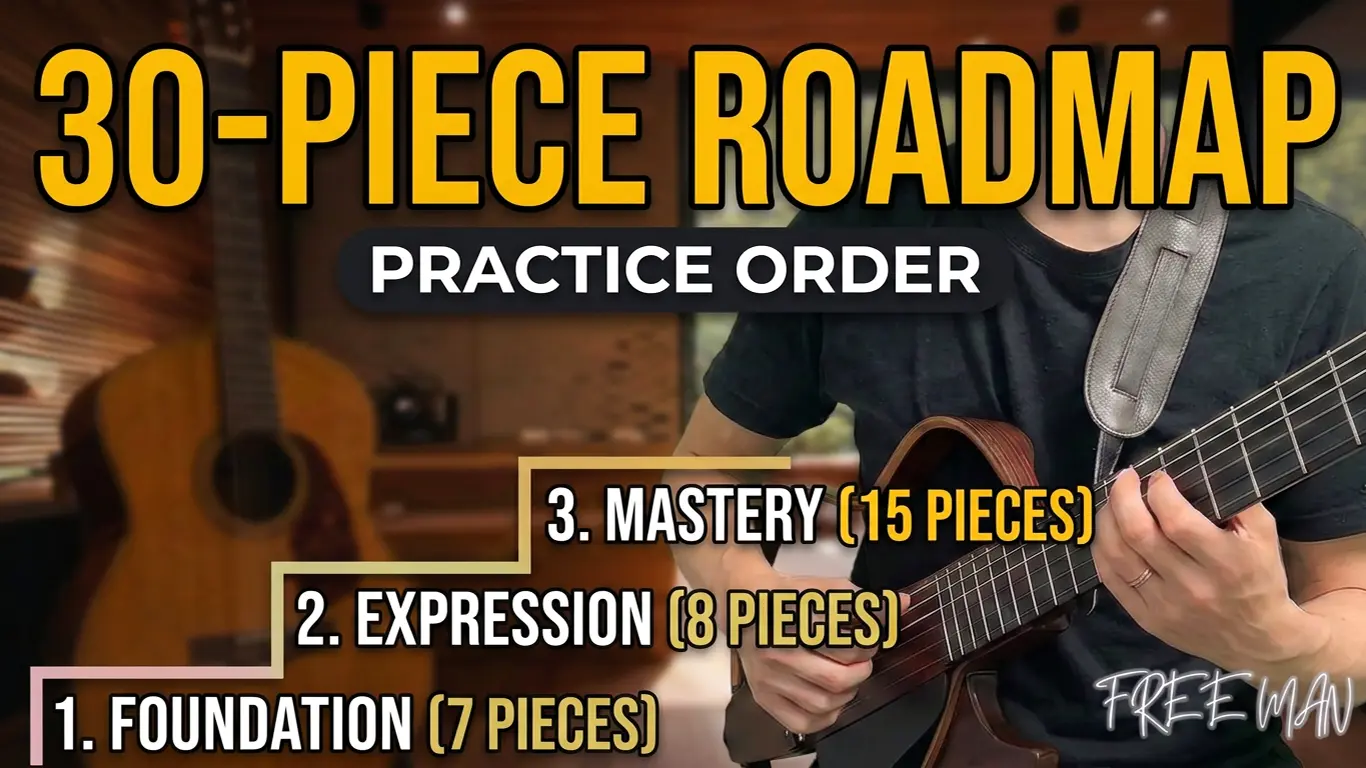
Apply these three angles to a 30-piece order, and you get Classical Guitar Pieces for Beginners: A 30-Piece Roadmap.
What Freeman 365 Studio Solves
Why I Designed 30 Pieces Around Purpose
Freeman 365 Studio’s practice blueprint is made of 30 pieces.
They aren’t ordered by difficulty, by length or by how famous they are. They follow the order in which technique is built.
The first piece is the entrance to the whole blueprint. What you learn in it is the prerequisite for the second. What you learn in the second is the prerequisite for the third. The chain runs to piece 30.
Read as a map, piece 1 is “checking where you are,” and piece 30 is “arriving.”
Design Axes: p-i-m-a, Scales, Tremolo
Every piece has a clear design axis.
Some focus on individual right-hand fingers (p, i, m, a). Their main purpose is to build independence in a specific finger.
Some focus on scales, to put the flow of notes across the fretboard into your body.
- Tremolo focus
- Melody focus
- Rhythm focus
- Tempo focus
- Scale focus
Each piece is designed to train a specific skill intensively.
Combine them in the right order, and technique builds up systematically.
A Concept Hard to Find Elsewhere
Traditional classical guitar materials often follow the order of performance difficulty.
What sets Freeman 365 Studio apart is that I create each piece from the structure of skill-building.
I design each one from this logic: “To build this finger movement, this pattern in this piece is the best fit.”
Designs such as a piece completed by p, i and m moving the same way, or a piece that doesn’t use m, may be hard to find in older materials.
Breaking down each finger’s role and training them one by one is the core of this blueprint.
With a Blueprint, Practice Becomes an Experiment
Practice with a blueprint, and each session means something different. You can think, “Today I’m testing this skill.” Whether it goes well or not, that’s today’s gain.
This feeling is nothing like obligation. When every session becomes a chance to discover something, that’s the inner engine that keeps you playing for years.

Guitar Practice Order: FAQ
Can I decide my practice order myself?
Yes. Start by reviewing your practice through purpose, prerequisite and next step. For how to structure your time, see How to Design a 15-Minute Guitar Practice.
What if there’s a piece I really want to play?
A piece you badly want to play is a source of drive. Keep going with it.
But most pieces need several skills at once. Work out which skills the piece requires, and build them first in separate practice. You’ll take fewer detours.
How soon will changing my order show results?
It varies from person to person, so I can’t promise a timeline. Try it for a week and see whether your practice purpose has become clearer.
Actually trying it, and making your purpose clear, is what brings you closer to the shortest path.
Summary: Design Your Practice Order
On guitar, the order of your practice changes your progress more than what you play. Sheet music is performance information, not a practice blueprint. Decide purpose, prerequisite and next step, and your practice becomes a blueprint.
Start with the free 15-minute blueprint, the base of your practice. Freeman 365 Studio offers practice blueprints designed around purpose and order. You’ll get the details after you sign up with your email.