
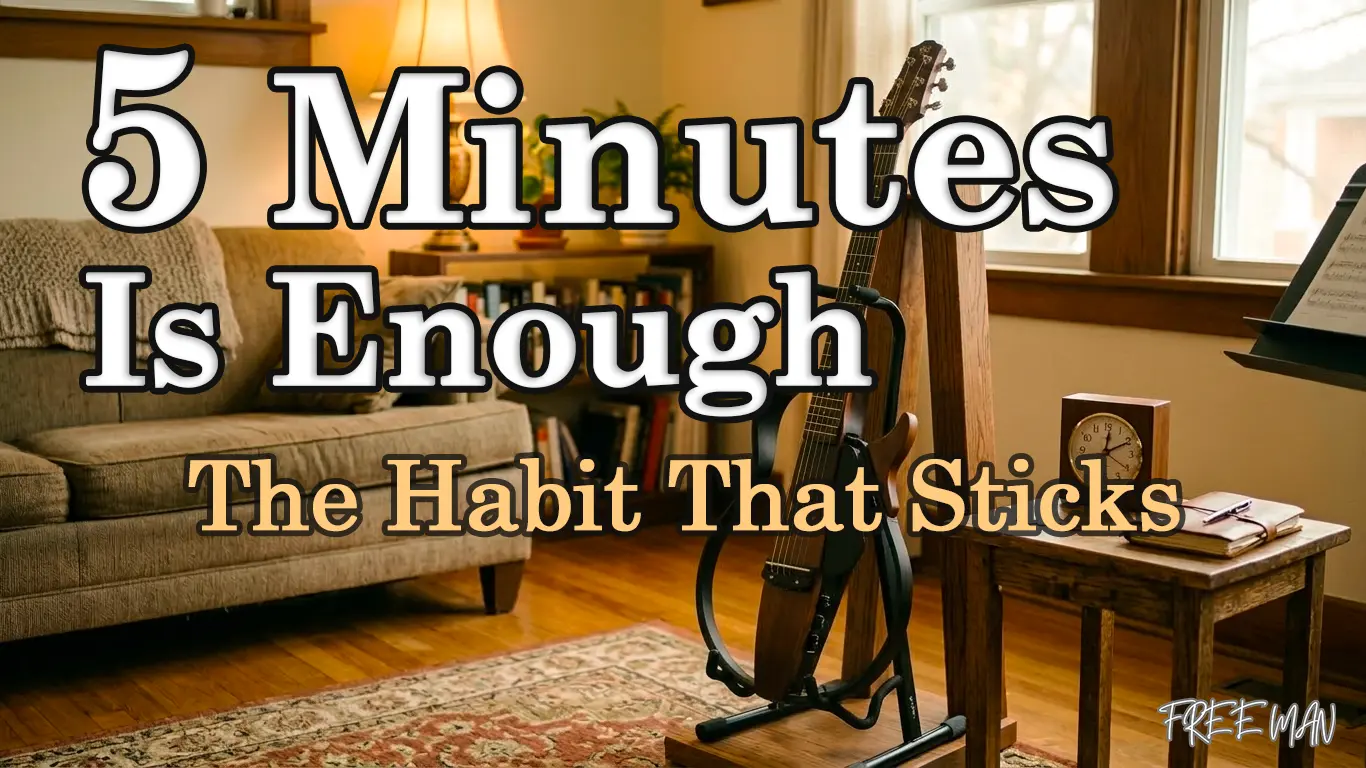
It’s not how long you practice. It’s whether you’re in a state where you actually can.
Why 5 Minutes a Day Beats 2 Hours Once a Week
The idea that “more practice time equals more improvement” is only half true.
Someone who touches the guitar for 5 minutes every day and someone who cram-practices for 2 hours on the weekend end up with a clear gap in progress after a month. There’s a straightforward explanation for this.
Skill sticks through short, frequent repetition far more than through long, occasional bursts of focus. Five minutes a day gives your brain roughly seven times more exposure than a single two-hour session once a week. That difference in frequency directly drives how fast you improve.
What People Who Stick With It Actually Do
They Leave the Guitar Out
A guitar in its case doesn’t get played. The small friction of having to take it out is all it takes to become a reason to skip today. People who stick with it keep the guitar on a stand, somewhere it’s always in view. Every time it catches your eye, your hand reaches for it. Sitting on the couch, it’s within arm’s reach without even thinking about it. That environment design is what builds the habit of touching it daily.
Silent guitars are light and compact enough that leaving one out in a room barely takes up any space. It’s within reach the moment you feel like playing. That state of “zero friction” naturally raises how often you practice.
They Don’t Aim for a Perfect Session
People who stick with it are fine with “just one phrase today” or “tune up and play a single note.” Some days end after 5 minutes, but the fact that you touched the guitar still counts. It’s easy to imagine the gap, a year later, between someone who fully skips days they can’t practice perfectly and someone who shows up for even 5 minutes on those same days.
Deliberately lowering the bar for yourself is often what sustains consistency. The person who can give themselves permission to say “5 minutes is enough today” ends up going the furthest, in terms of actually sticking with it.
They Don’t Beat Themselves Up on Bad Days
Didn’t play well today? That’s fine. They make a point of only comparing today’s self to yesterday’s self — not to other people, not to some ideal version of themselves. They avoid watching skilled players on social media and letting it get them down.
The measure they use isn’t “did I play well,” it’s “did I show up today.” Designing your standard that way is a real psychological skill that supports long-term consistency.
They Treat Practice Time as a Reward, Not a Task
For people who stick with it, practice isn’t an obligation. It seems to function as “time that belongs only to them” carved out of the day.
After work, after the kids are asleep, in the quiet of the morning — when playing guitar during that time becomes something to look forward to, there’s no reason left to quit.
Get a free PDF practice blueprint that actually works in 15 minutes a day.
Just your email address — unsubscribe anytime.
What People Who Don’t Stick With It Do
Setup Takes Too Much Time and Effort
Take the guitar out of its case, tune it, set up a chair and a music stand, dig out your practice materials. If just the setup takes 10 minutes, you’ve burned through your motivation before you’ve even started playing.
When the “cost of starting” is high, daily practice turns into a heavy obligation over time.
They Push It to “Do It All This Weekend”
“I’m busy today, I’ll catch up on the weekend.” Repeat that decision enough times, and the weekend gets pushed off too, for some other reason. Batch practice exists fine as a plan, but it rarely becomes a habit.
Anything that hasn’t become a habit gets a low priority in daily life by default. The result is that guitar stays permanently filed under “something I’ll get to eventually.”
Noise Problems Pile Up Into “I Can’t Play Today”
If you live in an apartment and only have free time at night, a regular guitar means several days a week hit the wall of “it’s too late, I can’t make noise.”
That accumulation of “days I couldn’t play” is what actually blocks a habit from forming. The most dangerous thing for consistency isn’t an active decision to quit — it’s the slow, silent disappearance that comes from too many days you simply couldn’t play piling up.
Why a Silent Guitar Is Built for This Kind of Consistency
Playable at night, minimal setup, ready the moment you put headphones on — these conditions maximize the state of “you can play the moment you feel like it.”
A structure that sustains itself is built far faster through environment than through willpower. No matter how strong your resolve, you can’t keep going in an environment where you simply can’t play. Flip it around: in an environment with no excuses left, even an ordinary person keeps going without trying particularly hard.
The Takeaway: 5 Minutes Is Enough. It Adds Up.
Improving at guitar comes down to how often you touch it, not how long each session runs.
Someone who touches it for even 5 minutes a day is looking at a different landscape a year from now.
Play for just 5 minutes today. It doesn’t need to be perfect. It doesn’t need to sound good. The simple fact that you showed up is what changes your future from here.