

If night is the only time you have, you’re actually practicing under some of the best conditions there are.
Night Practice Isn’t a Limitation — It’s the Best Condition
If you’ve been thinking “I can’t play guitar because night is the only time I have,” that assumption has it backwards. A nighttime practice environment actually stacks several genuinely favorable conditions in your favor when it comes to improvement.
Multiple studies suggest that practicing at night is effective for skill acquisition generally, not just for music. This article covers why, from both the science and the practical reality of guitar practice.
4 Reasons Night Practice Gives You an Edge
Reason 1: Fewer Distractions to Break Your Focus
Daytime comes with a constant stream of outside stimulation — calls, notifications, ambient noise, other people talking, shifting daylight.
All of it splits your brain’s attention and pulls focus away from practice. At night, that stimulation drops off, making it far easier to direct your attention entirely to your own sound and playing. A focused 15 minutes translates into more progress than a scattered hour.
With something as delicate as classical guitar, the quality of your focus feeds directly into the quality of your playing.
Reason 2: Sleep Locks In What You Just Practiced
While you sleep, your brain sorts through and consolidates the day’s memories. Research points specifically to REM sleep as a stage where motor skills learned that day get reinforced.
Finger movements, tonal memory, and phrase patterns you worked on right before bed tend to be more solidly locked in by the next morning. Practicing the exact same material right before sleep, versus earlier in the day, appears to make it stick better.
Some players notice they can play a phrase better the morning after a night practice session than they could the night before.
That’s not a coincidence — it’s memory consolidation doing its job while you sleep. Night practice is essentially built to take full advantage of that automatic, built-in learning support.
Reason 3: It Becomes the One Part of the Day That’s Yours
After work, chores, and taking care of family are done for the day, guitar stops being an obligation and becomes a release. Once playing shifts from “something I have to do” to “the thing I look forward to at the end of the day,” practice stops feeling like a burden entirely. Reach that point, and you’ll likely stick with guitar for a very long time.
After a whole day spent doing things for other people, having time to make sound for no one but yourself carries a value that seems to grow the older you get. Once night practice becomes a habit, a day without it starts to feel like something’s missing. That’s arguably what a habit is supposed to feel like once it’s fully formed.
Reason 4: Silence Sharpens Your Ear
Play guitar in the quiet of night, and you hear your own sound far more clearly than you do during the day. With less background noise competing for attention, your awareness of fine detail in the sound goes up.
Small differences in volume, how long a note rings out, the nuance in how a string vibrates — once you can pick up on these, your expressiveness as a player improves dramatically. Practicing in an environment where your ear is this sensitive is one real factor that accelerates growth in musical expression.
Get a free PDF practice blueprint that actually works in 15 minutes a day.
Just your email address — unsubscribe anytime.
How to Set Up Your Environment for Better Night Practice
Dim the Lights
A dim room lit by a single lamp is easier to focus in than a fully lit one. Dimming the lights alone changes the whole feel of a practice session. Your brain reads it as “wind-down time,” which loosens up tension in your body and lets your fingers move more freely. That translates directly into performance.
Put Your Phone in Another Room
Every notification breaks your focus. Some research suggests it takes several minutes to fully regain focus once it’s interrupted.
If three notifications during a 15-minute session cut your actual focused practice time in half, putting your phone in another room — or just switching off notifications — is genuinely worth doing.
Silent Guitar + Headphones = Total Immersion
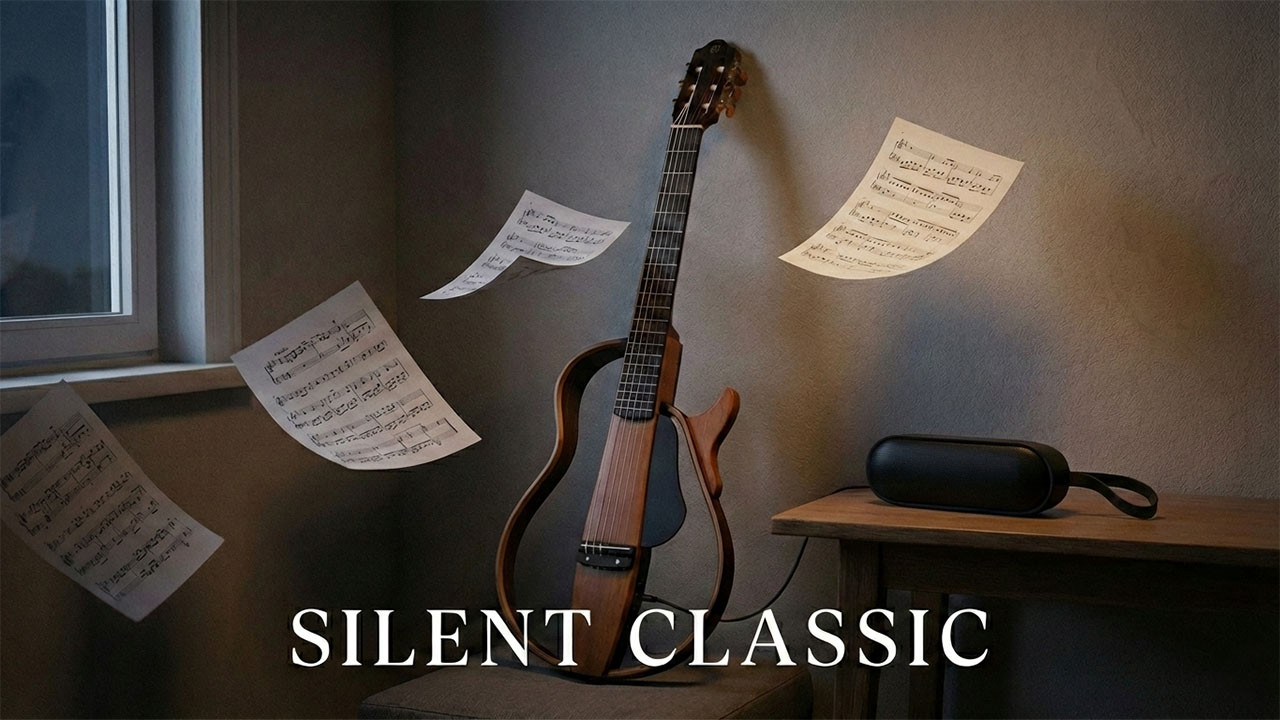
No sound escapes into the room, and the only thing you hear is your own playing through headphones — that’s about as close to a perfect practice environment as it gets. Even at midnight, you barely have to think about neighbors or family. With this setup, “night is the only time I have” stops being a constraint and becomes the entry point to the best practice environment available to you. A dim room, headphones on, guitar in hand. Once you know what that time feels like, there’s no longer a reason left to quit.
The Takeaway: If Night Is All You Have, You’re Actually Lucky
Quiet surroundings, memory consolidation right before sleep, the release of an unstructured close to the day, and heightened sensitivity to sound — these are all conditions unique to people who practice at night. What felt like a constraint might actually be your biggest advantage — it’s worth letting that sink in.
Having only nighttime available might mean you’re sitting on a better practice environment than almost anyone else.