What separates people who can improve without ever setting foot in a classroom from people who can’t?
Whether Self-Teaching Works Comes Down to Conditions, Not Method
There’s an ongoing debate about whether you should take lessons. Some people make the case for lessons, others swear by teaching yourself. This article isn’t going to settle that. It’s not an argument against lessons, either.
But what if there are specific conditions that determine whether self-teaching actually works?
Understanding those conditions precisely lets you judge what genuinely fits you. This article lays out, concretely, what separates people who can stick with self-teaching from people who can’t.
3 Conditions for Successfully Teaching Yourself Guitar
Condition 1: You Can Listen to Your Own Playing Objectively
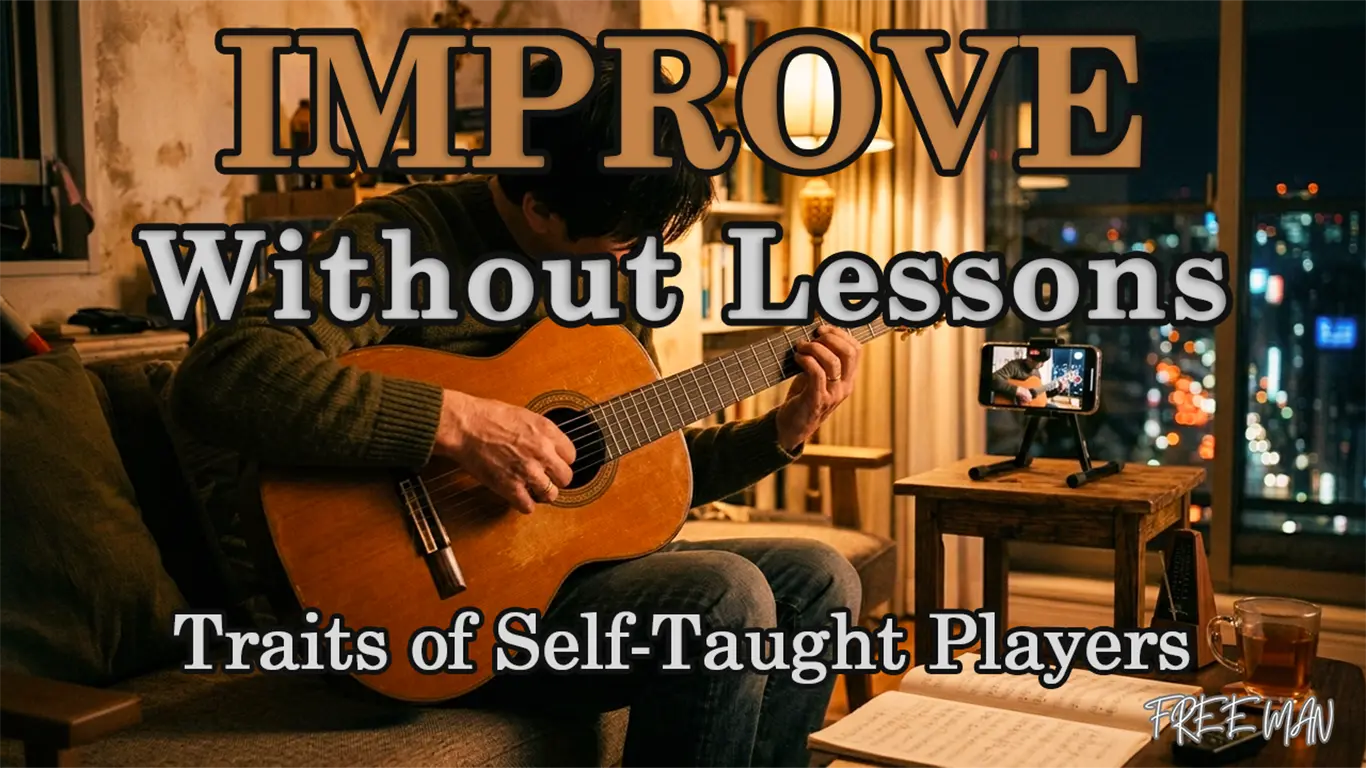
Someone who can record themselves and listen back will reliably improve, even without a teacher. Record your own playing, and if you can judge for yourself what’s working and what isn’t, you can correct course without anyone else’s input. All it takes is a smartphone, and you can start today.
Listening back reveals a lot you never noticed while actually playing — timing that’s slightly off, uneven volume, how often you’re missing notes. These are far easier to catch on playback than while you’re focused on playing. Anyone who can build a habit of recording and reviewing once a week already has the single most important skill for teaching themselves successfully.
Condition 2: Your Goals Are Specific and Simple
Vague goals like “I want to get better” or “I want to really play someday” tend not to hold up under self-teaching. People who set specific goals — “play the first 8 bars of this piece cleanly within 3 months,” “get through this one phrase without stopping by the end of the week” — have what it takes to keep making progress on their own.
How sharply defined your goal is directly affects how much momentum self-teaching has. A sharply defined goal dramatically raises your odds of hitting it, and the moment you do, the next one comes into view. Keep that cycle going, and self-teaching turns into a self-contained learning system.
- What does a “sharply defined” goal actually look like?
-
It means you have a concrete picture of the end result you’re aiming for, a logical path to get there, and a goal specific enough that you can act on it immediately.
Condition 3: You Have a Daily Practice Habit, Even a Small One
Someone who touches the guitar for 5 minutes a day will improve faster than someone who attends a weekly lesson. This isn’t a matter of opinion — it holds up as a fact about how the brain learns.
Skill sticks through short, frequent repetition far more than through occasional, longer bursts of focus. The single biggest advantage of self-teaching is freedom over time and place. If you can put that freedom to use and touch the guitar daily, self-teaching is genuinely a good fit for you.
Get a free PDF practice blueprint that actually works in 15 minutes a day.
Just your email address — unsubscribe anytime.
Signs Self-Teaching Might Not Be a Good Fit
You’re Constantly Anxious About Whether You’re Doing It Right
If you’re always uneasy about whether your playing is actually correct, you need something that gives you feedback. That anxiety gets in the way of focused practice and makes it hard to feel like you’re actually improving. In this case, a teacher — or reliably good video content — is the realistic solution.
Your Motivation Depends on Outside Validation
If “playing for someone and getting praised” is what actually keeps you going, a class or practicing alongside others is probably a better fit than teaching yourself. If solo practice doesn’t feel enjoyable to you on its own, self-teaching turns into a lonely obligation. Knowing honestly which type you are is the foundation for choosing the right environment.
How to Actually Use Content to Support Self-Teaching
Stick to as Few Sources as Possible
If you’re pulling from YouTube, books, or online courses, don’t spread yourself across a lot of them in a short window — concentrate on one source instead.
Reference several sources at once, and the moment they contradict each other, you lose any clear sense of what’s actually correct. Pick one carefully-chosen, trustworthy source, and build your practice around it — that’s the basic design principle for effective self-teaching.
Resolve Questions as They Come Up, Don’t Let Them Pile Up
Most of the places people get stuck teaching themselves are things a quick search would resolve. If you have a habit of searching specific questions the moment they come up — “why won’t this note come out,” “why can’t I do this finger movement” — you’ll have an easier time progressing on your own. Let questions pile up under “I’ll look into it eventually,” and your practice stays stuck exactly where it got stuck.
The Takeaway: Daily Practice Matters More Than Self-Taught vs. Lessons
Whichever path you choose, progress slows down if you’re not touching the guitar daily. And whichever path you choose, progress speeds up if you are. Build the habit first. Choose the method after that — that feels like the correct order.
If you already meet the conditions for self-teaching, you can start today. If there’s a condition you’re missing, getting that in place comes first.