Making your first guitar a silent guitar — here’s what that does for a beginner’s odds of sticking with it.
Your First Instrument Decides Whether You Stick With It
When people start guitar, most default to “whatever’s cheapest” or “whatever looks nice,” or they just buy whatever’s labeled a “beginner set.” But it goes without saying that your very first instrument has an outsized effect on whether you actually keep playing.
The tool you choose shapes whether the environment supports sticking with it — before willpower or effort even enter the picture.
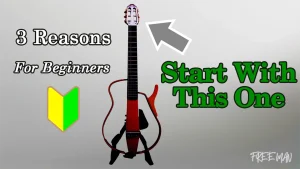
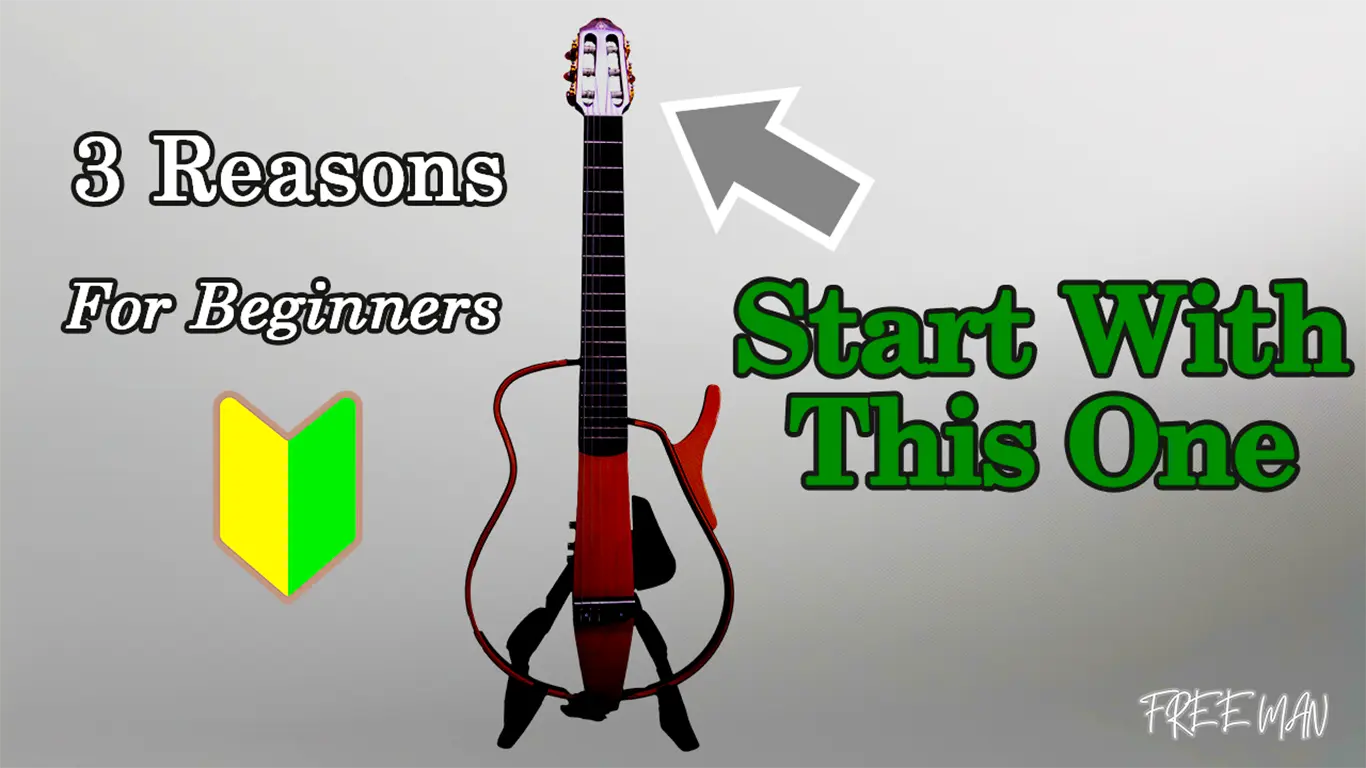
This article narrows it down to three reasons beginners should make a silent guitar their first instrument.
It’s about how the structure that causes beginners to quit can be changed simply by choosing the right tool.
This isn’t an argument for “silent guitar forever.”
Whenever you feel ready — once your environment allows it, once your fingers have toughened up, whatever the reason — picking up a full acoustic classical guitar is always an option sitting right there in your hands. That’s the premise here.
Reason 1: It Solves Every Common Reason Beginners Quit
One Guitar Solves the Noise, Pain, and Time Problems
The top reasons beginners quit guitar are: living somewhere they can’t make noise, finger pain that makes practice unsustainable, and never having enough free time to practice. These look like three separate problems, but they’re actually the same underlying structure — all three create a state where you simply can’t practice.
A silent guitar answers all three at once. Its volume is low enough to play in apartments, rented units, and at night. Models like the SLG-200NW use nylon strings, so there’s minimal strain on your fingertips from day one. With just headphones, you can practice even late at night, so a long workday doesn’t cost you your practice time.
One instrument solving all three major causes of quitting at once — no other option has this structure. Very few instruments can solve this many problems with a single purchase, which is exactly what makes something like a silent guitar such a strong first choice.
Designed So You Run Out of Excuses Not to Play
The difference between people who stick with guitar and people who don’t isn’t willpower.
It’s the number of available excuses. Choose a silent guitar, and excuses like “can’t make noise today,” “my fingers hurt, I’ll skip it,” or “it’s too late at night” all disappear. In an environment with no excuses left, people naturally keep playing.
Reason 2: It Fundamentally Improves Practice Quality
What You Hear Through Headphones Trains Your Ear
Play a silent guitar through headphones, and you hear your own sound with striking clarity. Outside noise is completely cut out, so your attention lands entirely on the sound you’re producing. This setup naturally builds the single most important practice habit from day one: really listening to your own playing.
Train your ear, and your fingers follow. Someone who can objectively hear their own sound can identify what’s missing on their own. You don’t need a teacher for that — a recording and a replay button get you most of the way there. The headphone environment on a silent guitar is one of the strongest supports there is for self-taught improvement.
If you’re relying on headphones with a silent guitar, choose a model with a built-in mic simulator, like the SLG-200NW.
There’s a real limit to how convincingly a classical guitar’s natural resonance can be recreated through headphones alone, so it’s worth leaning on the technology built for exactly that.
A Practice Environment With Zero Distractions
Practice on a regular guitar, and there’s always a background thought running: “I should probably play a little quieter.” That thought pulls focus away from your playing. On a silent guitar, volume simply isn’t something to worry about, so 100% of your attention goes to the music itself. Practice quality depends far more on focus than on how many minutes you log.
Get a free PDF practice blueprint that actually works in 15 minutes a day.
Just your email address — unsubscribe anytime.
Reason 3: It’s a Real Instrument You’ll Use for Years
Not a Practice Compromise — a Performance-Grade Instrument
Silent guitars are sometimes misunderstood as “an instrument that can’t really make sound, only good for practice.” In reality, more professional players are using them for recording and touring. Yamaha’s silent guitar lineup comes close to a standard classical guitar in terms of acoustic engineering and fretboard construction.
(With the right technique and setup, I’d argue they can offer even more than that.)
An instrument you buy as a beginner can keep serving you long after you’ve improved. You never have to think “I’ll upgrade once I get better.” Sticking with the same instrument over the long term builds real attachment to it and a stability in your playing. Not having to deal with the cost and hassle of upgrading is also, practically speaking, a reasonable choice over time.
The Real Cost Math Behind the Price Tag
Some people look at the price of a silent guitar and think “that’s expensive.” But run the comparison against the right alternatives, and the picture changes. Building a soundproof room costs at minimum several thousand dollars. A year of lessons runs anywhere from a few hundred to well over a thousand dollars depending on frequency. Add commute time and transportation costs, and the ongoing cost of lessons adds up fast. (To be fair, there are real benefits to lessons too — they can help you stick with it and make learning more enjoyable.)
A silent guitar minimizes all of that at once. Considering that one instrument keeps solving multiple problems for years, isn’t that a reasonable call as an upfront investment?
Honest Answers to Common Questions
“Can I Only Play Classical Music on It?”
A silent guitar isn’t limited to classical repertoire. Pop, bossa nova, original songs, singing along with your own accompaniment — it handles whatever music you actually want to play. The soft tone of nylon strings sounds beautiful across genres, not just classical.
“Isn’t It a Little Boring to Look At?”
Think about how often you’d actually be showing a silent guitar to someone else.
It’s true the volume is low, and there’s a real ceiling to how much sound you can put out playing solo.
But if your practice style is fundamentally solo, whether you can keep playing every day usually matters a lot more than how the guitar looks. An instrument isn’t meant to be displayed — it’s meant to be played.
Honestly, I’ve never personally found making music with just one guitar to be “boring” (laughs).
If anything, solo guitar might be the most dramatic form there is — technically, emotionally, and expressively. Maybe that’s just me.💦
The Takeaway: Your First Guitar Decides If You Continue
Choosing an instrument is designing the entrance to a hobby. The people who set up an environment they can sustain from day one are the ones who end up enjoying it the longest.
A silent guitar may be one of the instruments that answers that design challenge most honestly.
It solves the three biggest causes of quitting at once, raises the quality of your practice, and stays useful for years. A first guitar that checks all three boxes isn’t just an instrument — it’s the environment you’re building for yourself to keep going.