You can’t press the F chord. Your finger hurts when you play a barre. Plenty of people feel this way and give up on guitar.
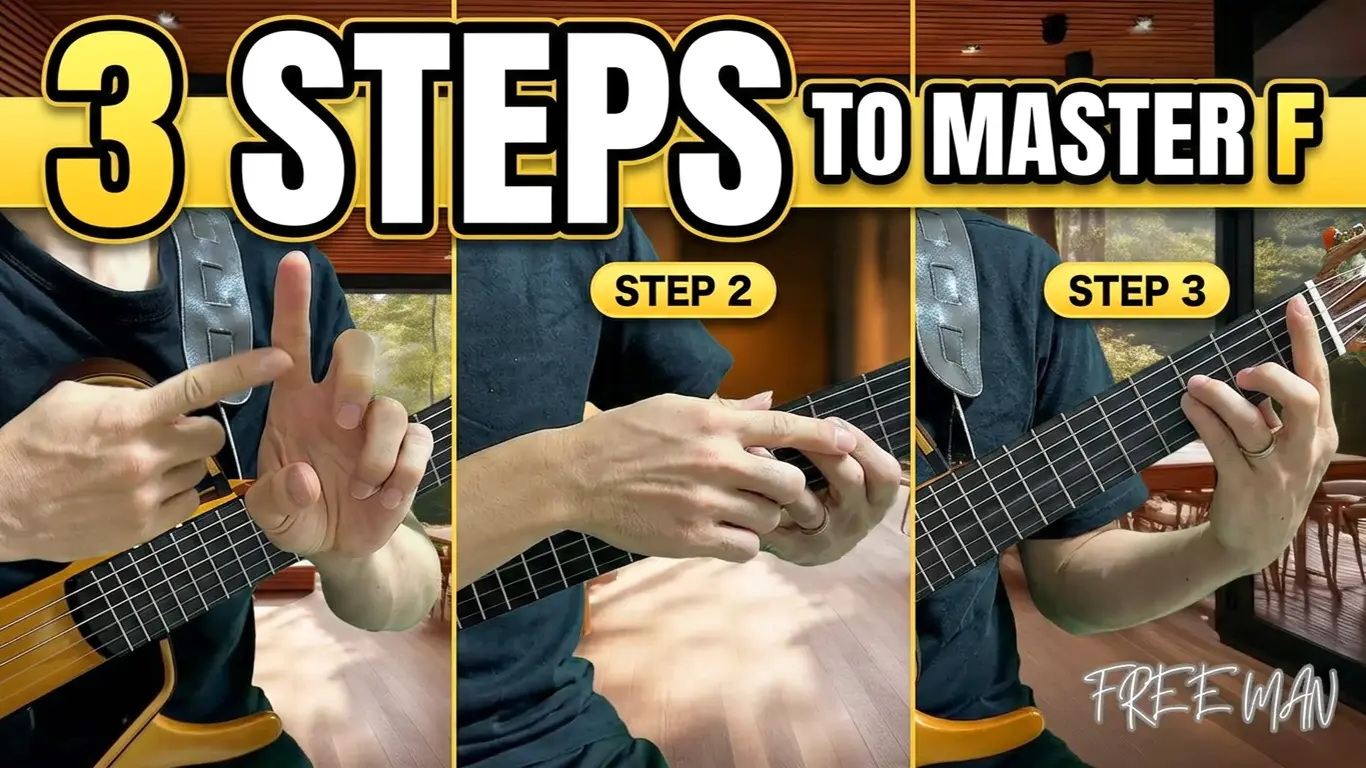
In this article, I explain barre chord tips for guitar, using the F chord as the example. I’ll sort out why the F chord won’t sound, then walk you through three steps to play it without force, from the viewpoint of using it inside a solo guitar piece, not as a chord change in song accompaniment.
When I first started playing guitar, I hurt my fingers on the F chord many times myself.
- Players whose fingers hurt on a barre and who can’t press the F chord
- Players who put the guitar down for a while and want to start again
- Players who want to use the F chord inside a piece
Along the way, I’ll suggest concrete ways to get past the barre (barre chord).
3 Reasons You Can’t Press the F Chord | Why the Barre Hurts
A barre is a technique in which your index finger presses several strings at the same time. The F chord is the typical barre chord, and one of the first walls where people tend to give up after starting guitar.
Not being able to press it is not a lack of talent. In most cases, the cause is one of these three.
Reason 1: A Barre Gives One Finger an Unreasonable Job
In the F chord’s barre, your index finger presses six strings at the same time with even pressure. Your other fingers also press frets. It demands finger strength and joint flexibility at once.
A beginner’s hand hasn’t yet developed to the point of handling this movement. If the barre hurts or you can’t press it, that is a matter of your hand not being ready yet.
Reason 2: Different Instruments Need Very Different Force for a Barre
Even for the same F chord shape, a steel-string guitar and a nylon-string classical guitar need very different amounts of force.
Steel strings have high tension, and pressing all six strings evenly takes a fair amount of grip strength.
In my view, many people who gave up on the F chord had been attempting it on a steel-string guitar. I myself also had the experience of switching to a classical guitar and finally getting the sound out easily.
Reason 3: You’re Aiming for the Finished Form From the Start
Many people aim, from the first day of practice, for a state where “all six strings ring out cleanly.” But a step-by-step approach, where you gradually increase the number of strings that ring, makes more sense.
Not allowing for this in-between progress and deciding “I can’t play it” is a major reason people quit guitar early.
Barre Chord Tips | 3 Steps to Play the F Chord Without Force
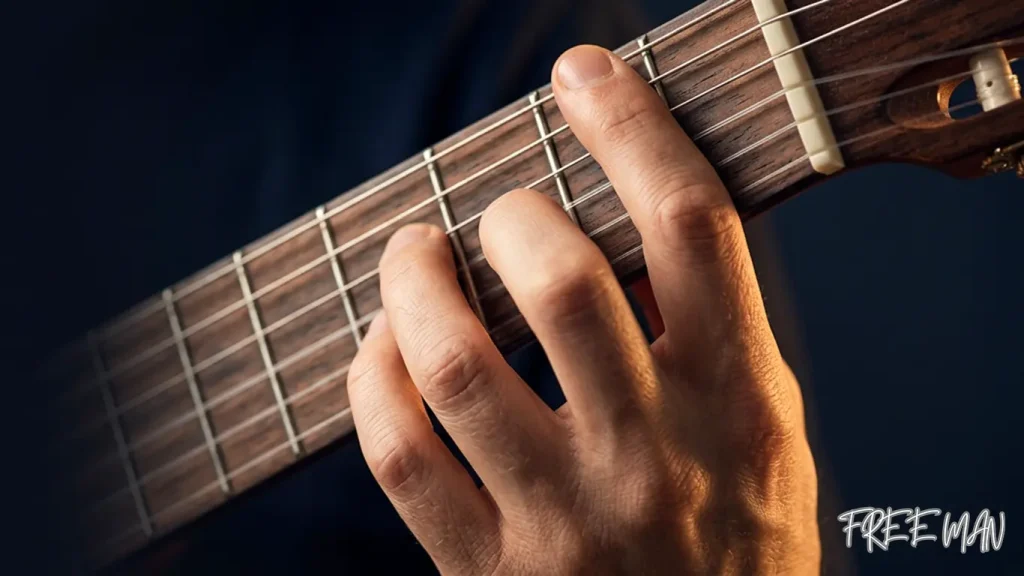
From here, I put the tips for the barre and the F chord into three steps (Point A–C) you can check through actions, not feel. You’ll work in order up to using the F chord inside a piece.
Point A: Barre Tips | Build a Relaxed Form (Startup Test)
Many people press the F chord by putting all their strength into the index finger. This is actually one cause of finger pain in a barre, and it backfires.
Your finger has an angle at which it touches the strings firmly even without force. Bend the first joint slightly and bring that side of your finger against the strings. That alone greatly reduces the force you need.
At this stage, what matters is not producing a clean sound but whether you can hold this form while staying relaxed. If the pain or discomfort is strong, don’t push on. Take a rest.
Point B: Barre Tips | Find Where It Breaks, Move Your Thumb (Load Test)
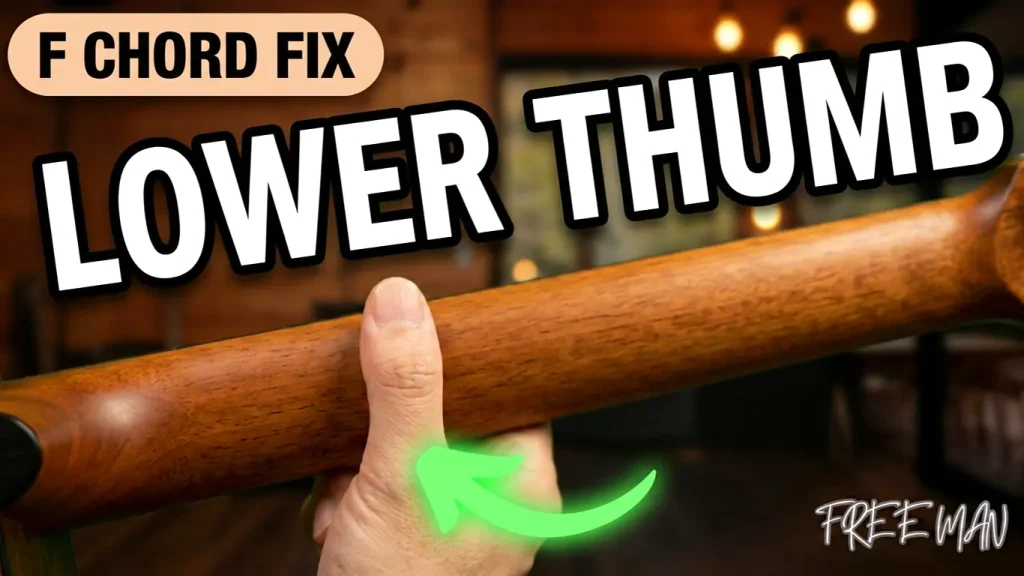
This is the part of the algorithm that puts the most load on you. It calls for a half barre and a left-hand stretch at the same time.
- What is a half barre?
-
A technique in which your left index finger presses only some of the strings together (usually strings 1 to 3, or 4), not all of them.
You don’t need to make everything ring cleanly from the start. What I want you to watch is “where it breaks down.”
The spot where it breaks down is exactly what you need to fix.
What I’d like you to check is your thumb position.
Many people whose fingers tire place their thumb toward the top of the neck (the upper end). Try lowering it slightly below the center. Just by changing the pivot point, the way pressure is distributed on your index finger changes greatly.
Point C: F Chord Tips | Play It From the First Note (Integration Test)
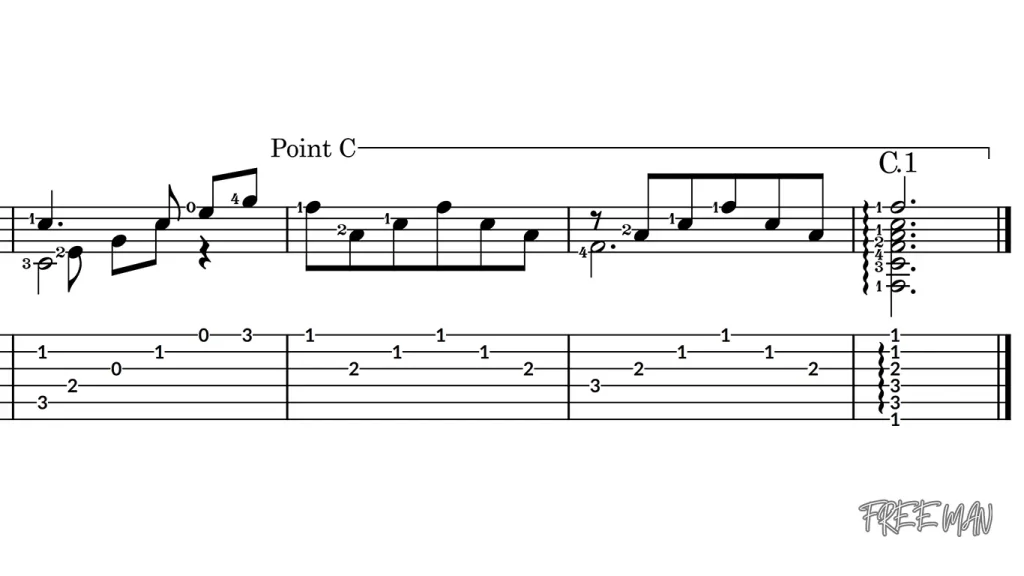
Finally, you connect these movements inside a piece. The first note is played on string 1, but you start playing with your hand already in the F chord form.
At the end of the piece (THE F-Chord Algorithm), you need to press a full F chord across strings 1 to 6. However, when you sound the first note, you don’t necessarily need to press the F on string 6.
When you get this far, the F chord changes from “a shape you just press” to “a shape you can actually use.” You don’t need to be able to play all the way through.
What matters is whether you can get through A, then B, then C, one at a time.
Watch the Barre and the F Chord Demonstrated on Video
I demonstrate and explain Point A–C inside an actual piece. The score for the section used in the video is also shown there.
Watching and listening makes it quicker to understand.
Get the Full Version of THE F-Chord Algorithm
This article and the video cover the thinking behind THE F-Chord Algorithm and a demonstration of the main parts. The full version covering every part comes together with the “15-Minute Practice Blueprint,” the foundation for everything, with an email sign-up.
After you sign up, I’ll send you emails over five days. Please check the contents, “Day 2: THE F-Chord Algorithm PDF (free),” on the sign-up form below.
Summary | The Barre Tip Is in Procedure, Not Force
You can’t press the F chord, or the barre hurts your fingers. That is not a lack of talent but a matter of structure and how you proceed. To play without force, check these three in order.
- Bend the first joint slightly and keep the barre form while staying relaxed
- Find where the form breaks down under load, and lower your thumb slightly below the center
- Start playing the F chord in a usable form from the very first note
Rather than blindly enduring sore fingers, it is often faster to bring in structure and move forward a little at a time. Before you give up on guitar, start with the Point A form.