

Your fingerpicking right hand changes when you bring in classical guitar form. Across genres, right-hand design decides the depth of your music.
When you fingerpick on electric or acoustic guitar, does your sound feel a little muddy? Does the melody get buried in the accompaniment?
Part of the cause may be finger independence in your right hand. This article shows how to bring classical guitar right-hand form into electric and acoustic fingerpicking.
Why Classical Form Helps Your Fingerpicking

Classical guitar is often seen as a special genre: only for classical music, with strict form and a high barrier to entry. Many people picture it that way.
It seems rare for electric or acoustic players to think, “I should borrow classical form.”
Yet the classical guitar right hand is packed with principles that work in any genre. After 30 years of playing, I’ve come to feel they apply to fingerstyle as a whole.
Electric fingerpicking and acoustic fingerstyle: the principles of the classical right hand carry over to both.
Finger Independence Is Universal
Whatever the genre, the right hand of a string instrument needs the same thing: each finger plucking independently, with the volume and tone you intend.
Classical guitar trains this principle more thoroughly than any other genre.
The division of roles between p, i, m and a, independent fingers, and control of finger angle and speed for tone. A method for training all of this systematically has been refined over centuries.
It works for people who don’t play classical guitar, too.
What Fingerpickers Often Miss
Fingerstyle players tend to keep practicing with a right hand that “sort of works.”
I did too. I used to think, “Next to fast alternate picking and tapping, fingerpicking has its limits.”
You hold the chord and move your right hand in patterns. Learn enough arpeggio patterns, and you can play songs. But at some point, your fingerpicking can stop improving.
- Your sound has no character
- The melody doesn’t stand out
- Melody and accompaniment blur together
- Notes aren’t evenly clear
These tend to happen when your right hand isn’t independent enough.
The classical guitar world is full of pieces that seem built to get you past exactly this right-hand barrier.
What Changes With a Classical Right Hand
Clear, Separated Notes
The first thing to change after adopting classical right-hand form is note clarity.
Once each finger moves independently, every note sounds distinct. Each note of the arpeggio rings out on its own. That’s clarity.
When players switch from a pick to fingers and feel their sound is “somehow muddy,” this clarity is missing. Training classical form solved this for me.
If you play electric seriously, it’s close to the feeling of fast alternate picking ringing evenly.
I know this from experience. There was a time I played technical bands like Extreme and Dream Theater with a pick, shredding like crazy.
But with my fingers, I couldn’t play Sunburst, Andrew York’s classic classical guitar solo.
I couldn’t even play the Carcassi études found early in method books.
My left hand could move, but my right hand couldn’t keep up. That was the huge difference.
A Melody That Stands Out
As you train your ring finger (a) to be independent, the melody line starts to rise to the surface.
One challenge of fingerstyle is making the melody stand out inside the accompaniment. The same hand plays both at once. To separate them, the finger carrying the melody has to move more strongly and clearly than the others.
Training an independent a builds exactly that skill.
A Gateway to Polyphony
Where this leads is the ability to play several voices independently at once.
- The bass moves
- The inner voice keeps the rhythm
- The melody sings
All three sounding at once, each with its own intention. That’s polyphonic playing.
Classical guitar has a way of thinking that makes this possible on a single instrument.
Reach this point, and you can play solo guitar anytime, anywhere.
It’s different from the virtuosic solo guitar you hear on electric or acoustic.
Polyphonic expression gives you access to the essence of the guitar, carried through centuries of history and still alive today.
Three Classical Form Elements to Start With
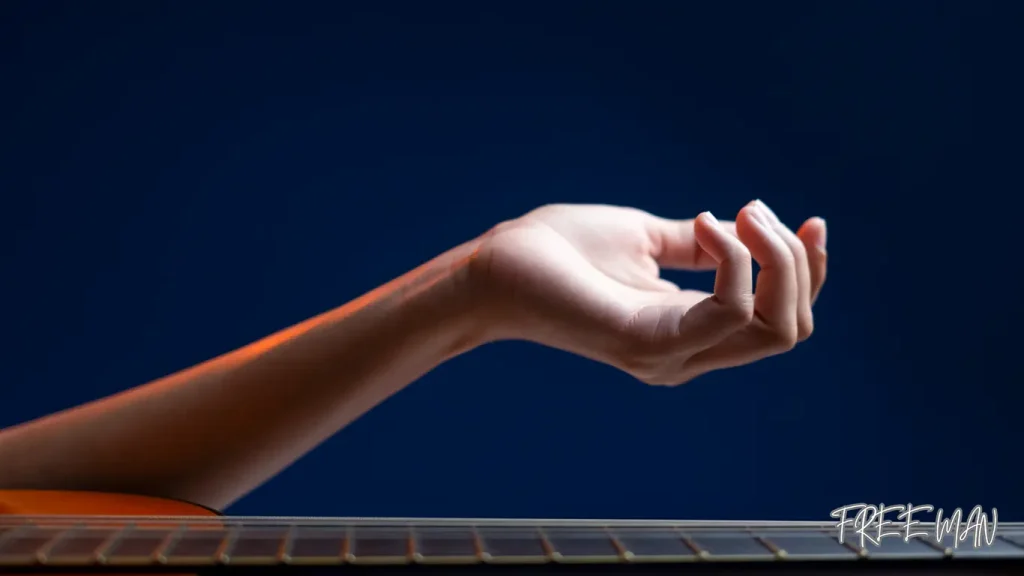
An Independent Thumb (p)
The first thing to adopt is an independent thumb.
Many fingerstyle players move the thumb together with the other fingers. In classical form, the thumb moves completely on its own. Playing the bass strings without being pulled along by the other fingers builds the foundation of your playing.
Start by consciously separating your thumb from the other three fingers.
Awareness of the Ring Finger (a)
Next, become aware of your ring finger.
Many fingerstyle players leave it as a finger they “barely use.”
In classical form, the ring finger is one of the key fingers for carrying the melody.
Just starting to use it on purpose, you’ll feel your playing open up.
A Stable Wrist Position
Classical form has a standard for wrist position and angle.
Keep your wrist at a steady distance from the strings, in a position where each finger can meet the string at the best angle. When the wrist is stable, the fingers are stable too.
When the wrist wobbles, finger movement loses stability. A stable wrist ties directly to the precision of your whole right hand.
If you feel pain or discomfort in your wrist or fingers, stop right away. Don’t change your current form all at once. Try one element at a time.
For independent finger exercises, see Classical Guitar Right Hand: Practice p-i-m-a Separately.

Fingerpicking Right Hand: FAQ
Should I use classical form on electric guitar?
You don’t need to change everything. Try the elements that are easy to adopt, and see whether they suit your playing.
Does this only work on nylon strings?
Finger independence works the same on any strings. Still, string tension and stiffness change the feel, so try it within a comfortable range.
How soon will I notice a change?
It varies from person to person, so I can’t promise a timeline. Try it for a week and check whether your note clarity has changed.
Next Step: Playing Musically
Once your right-hand foundation is in place, many guitarists feel the same urge: “I want to play more musically.”
When your notes are clear and the melody stands out, you start caring about musical expression.
- Shaping the tempo
- Dynamics
- The breath of a phrase
All of these depend on an independent right hand.
I explain the order in Guitar Practice Order: Sheet Music Is Not a Blueprint. The full picture, designed as an order of pieces, is in Classical Guitar Pieces for Beginners: A 30-Piece Roadmap.

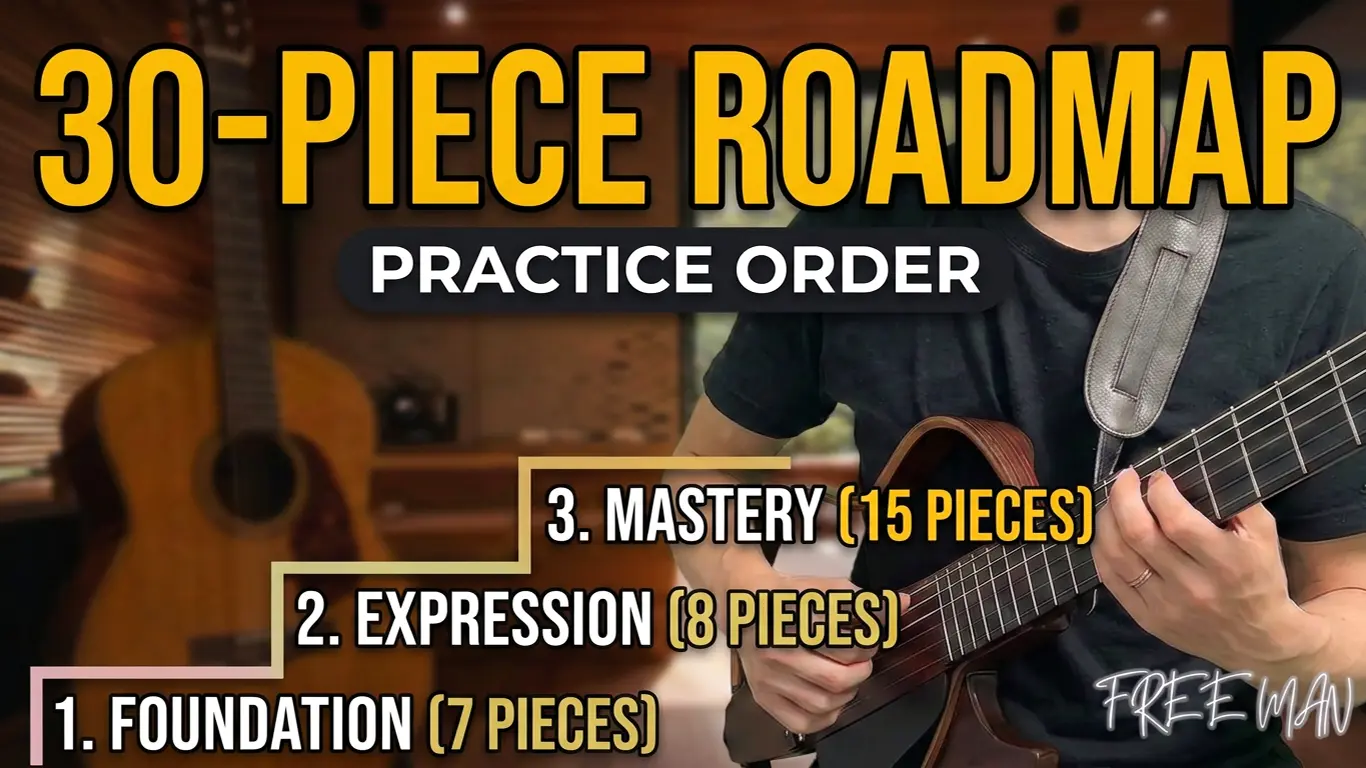
Start with the free 15-minute blueprint, your practice map. Freeman 365 Studio offers practice blueprints designed around purpose. You’ll get the details after you sign up for free.