The F chord isn’t guitar’s first real wall. Understand it correctly, and it’s a checkpoint anyone can get past.
The F Chord Is One of the Top Reasons People Quit Guitar
Anyone who’s ever taught guitar has heard some version of “I couldn’t get the F chord, so I quit,” more times than they can count.
The F chord is widely known as the first real wall for beginners. But this particular wall comes down every time, once you know the right approach and the right order to practice it in. Most people who got stuck on the F chord were simply chasing the right result with the wrong method. Here’s the fix.
If you’re playing on a classical or silent guitar, the F chord actually gets structurally easier. We’ll walk through why, step by step, along with everything else.
Why the F Chord Is Actually Hard
Cause 1: The Barre Chord Itself
The F chord relies on a “barre” — using your index finger to press down every string at once. One finger has to press six strings evenly, while your other fingers hold down separate frets at the same time. That demands both finger strength and flexibility simultaneously. In the early stages of learning guitar, neither your fingertip strength nor your joint flexibility has fully developed yet.
In other words, not being able to play the F chord isn’t about your ability. It’s simply that your body hasn’t finished the physical prep work yet.
Cause 2: Steel Strings Double the Difficulty
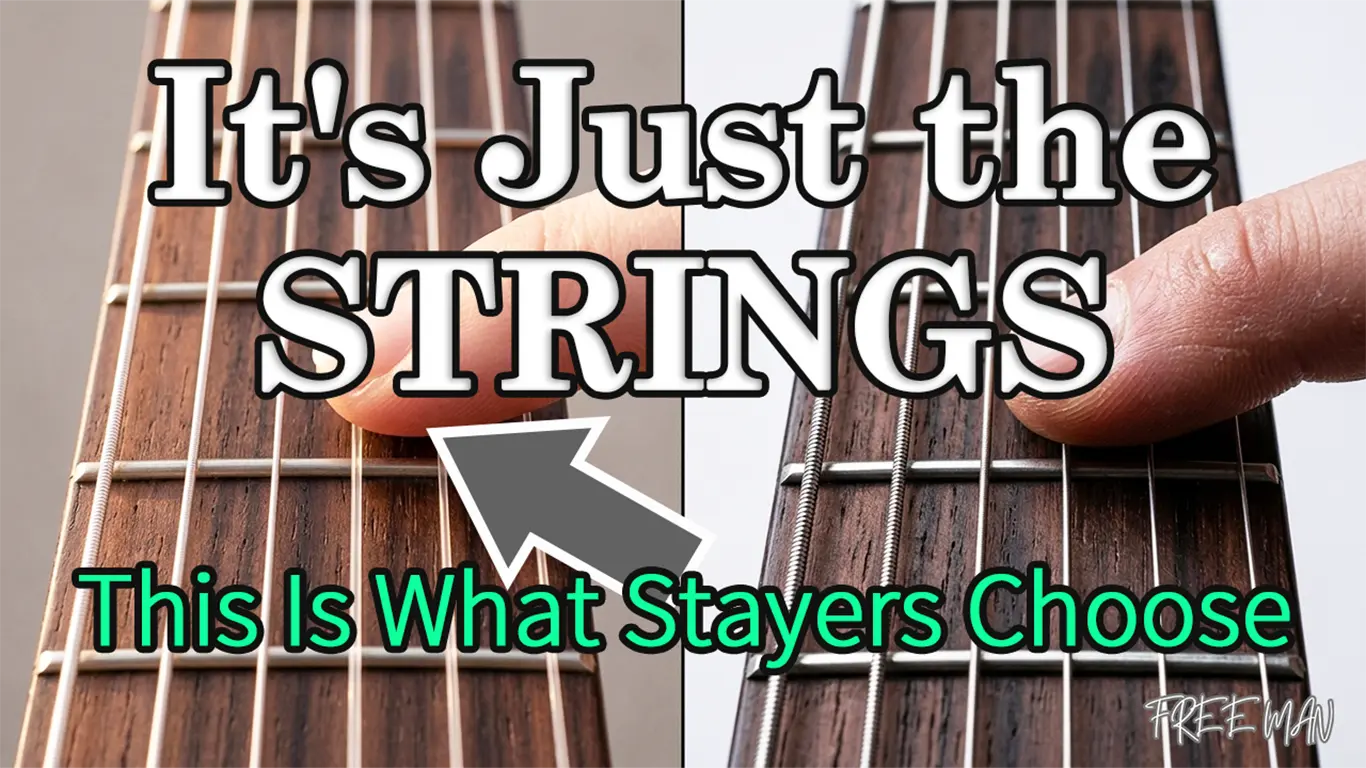
Try to barre the F chord on a steel-string guitar, and the force required jumps dramatically compared to nylon strings. Steel strings sit at a higher tension, and pressing all of them down at once demands real grip strength and fingertip power.
On a classical guitar’s nylon strings, the exact same F chord shape needs far less force and produces clean sound more easily.
There’s a real chance that a lot of people who gave up on the F chord share the same detail: they were attempting it on a steel-string guitar.
Cause 3: Expecting Perfection Right Away
When practicing the F chord, most people expect all six strings to ring out cleanly from the very first attempt.
In reality, learning it in stages works far better.
At first, it’s fine if only a couple of strings ring clean. Gradually, more strings come through. Refusing to allow yourself that gradual process, and declaring “I can’t play the F chord” too early, is a major cause of giving up prematurely.
A Step-by-Step Approach to Finally Playing It
Step 1: Start With a Simplified, Barre-Free Version
Skip the index-finger barre entirely at first, and start with a simplified F chord that only presses the 1st and 2nd strings.
Getting the sound of the chord into your body comes first. It’s fine if not every note rings — spend your first week just playing along with the general feel of the chord. The goal at this stage is purely to strip away any fear you’ve built up around the F chord.
Step 2: Isolate the Barre Itself
Practice the index-finger barre on its own, without engaging any other fingers. It doesn’t matter if it doesn’t sound right yet. Just search for the feeling of your index finger touching every string evenly, and the angle that lets you press down with the least amount of force possible.
Arching the first knuckle of your index finger slightly back tends to make contact with the strings more even. Finding that feeling is really the core of learning a barre chord.
Step 3: Practice a 5-String Version First
Instead of insisting on all six strings ringing at once, practice the F chord shape using only strings 5 through 1. Dropping the 6th string lowers the force required and makes it much easier to rack up small wins.
Let your body remember that moment the sound comes through clean. Stacking up that experience is the real shortcut to the full F chord.
Step 4: Practice Switching In and Out of It
Once you can hold the F chord on its own, move on to practicing transitions with other chords. C to F, F to G.
Repeating those switches at a slow tempo is what teaches your fingers the shape. Don’t try to play fast. Accuracy always takes priority over speed.
A Blueprint Built Specifically to Get You Past the F Chord
We’re giving away a free PDF blueprint(THE F-CHORD ALGORITHM) built specifically to help you clear the F chord.
Sign up with just your email address, and unsubscribe anytime.
Why Classical Guitar and Nylon Strings Make the F Chord Easier
Nylon strings sit at lower tension than steel, so barring them takes noticeably less force. Play the exact same F chord shape on nylon strings, and your odds of getting a clean sound as a beginner go up significantly.
After fighting the F chord on an electric-acoustic in my early days, I picked up a classical guitar almost on a whim — and the sound just came out. That experience is exactly why I believe the odds of clearing the F chord genuinely go up with the right instrument.
Like that experience, plenty of people who struggled with the F chord before end up trying again on a classical guitar and thinking, “wait, it’s really this easy?”
That’s not a sudden burst of talent. It’s simply that the instrument changed, and with it, how much force you actually needed dropped.
You Can Still Play Plenty of Pieces Without the F Chord
Here’s something important. You don’t need a perfect F chord to play beautiful music. Plenty of pieces in the classical guitar repertoire don’t require a barre chord at all. Making time to enjoy pieces you can already play, alongside your F chord practice, is essential for actually sticking with guitar.
Practicing that fights the F chord and nothing else tends to build resentment toward guitar as a whole. The F chord is a checkpoint — it’s worth keeping in mind that you can enjoy music the whole time you’re working on it.
But it’s also true that clearing the F chord (the barre) opens up your enjoyment of guitar by a real, noticeable margin.
The F chord (the barre) is a wall you can absolutely clear.
Use every bit of leverage your instrument gives you and every shortcut in this guide, keep sticking with guitar as the top priority, and take your time enjoying the process. 🎶
The Takeaway: The F Chord Isn’t a Reason to Quit — It’s a Doorway
If the F chord is what stopped you: what you’re reading here shows it may have simply been a matter of string tension and practice order.
Work through it step by step, in the right order, and the F chord becomes something you can play — reliably. If you’re starting today, spend just one minute practicing the index-finger barre alone. That one minute is the doorway to the view on the other side of quitting.