Sheet music is just one door into music. You don’t need to read it to start playing.
Do you assume that with classical or solo guitar specifically, not being able to read sheet music means you can’t even get started?
You don’t need lessons. You don’t need someone teaching you directly. You don’t need to rule out teaching yourself. None of that is true.
The first move is simply to enjoy playing guitar and keep going, until reading music becomes something you genuinely need.
The Myth That You Need to Read Music to Play Guitar Ends Today
Plenty of people who want to start guitar think “I probably can’t, since I can’t read music.” Others hit that exact wall in the past and quit because of it.
This is a major misconception.
Plenty of guitarists around the world play without ever reading sheet music. Notation is a tool for recording music — it isn’t the music itself.
This article clears up that misconception and lays out an entry point into classical guitar that works even for adults starting from scratch, teaching themselves, with no sheet music required.
Why You Can Play Without Reading Music
Reason 1: Your Ears and Fingers Learn Music Together
People are able to memorize music by ear. A melody you’ve heard many times can play back in your head without any sheet music at all. Training your fingers to translate that melody is exactly how you learn guitar without notation. You find the sound you already know by ear, and reproduce it with your fingers. Sheet music never enters the process. If anything, searching for notes without being tied to a page strengthens the connection between your ears and your fingers.
Reason 2: Tab Notation Does the Heavy Lifting
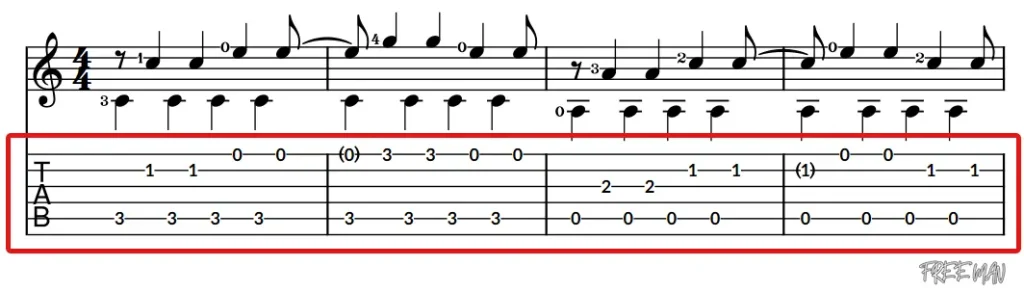
Guitar has its own notation system separate from standard sheet music, called tablature — “tab.” Tab uses six lines to represent the six strings, with numbers showing which fret to press. You don’t need any knowledge of standard notation to read tab; it tells you directly which fret on which string to play.
Countless tabs are published online, and searching for the tab of whatever piece you want to play usually gets you everything you need. Even without reading sheet music, tab alone opens up a huge number of pieces.
Why I Personally Stuck With Guitar in the Early Days
When I first started on electric guitar, tab notation is exactly what let me keep going.
I only picked up standard notation later, when I started learning classical solo guitar, and it came naturally through that process.
If sheet music had been put in front of me at the very start, I genuinely don’t think I would have stuck with guitar.
Reason 3: You Can Watch and Copy
YouTube has an endless supply of performance videos. Watch a video of the piece you want to play, copy the finger movements, and you can learn the piece that way.
With this method, you don’t need sheet music or even tab. Watch, and copy. It’s arguably the oldest way humans have ever passed music down. For anyone who learns well visually, this method works faster and more intuitively than reading notation ever could.
Learning visually well is a genuine skill in its own right. If that’s you, lean all the way into it.
There’s The Scoreless Blueprint that lets you play solo guitar using tab, no sheet music required.
Start with the free PDF practice blueprint that works in 15 minutes a day.
Just your email address — unsubscribe anytime.
The Benefits of Reading Music, and When You’ll Actually Need It
At What Stage Does Reading Music Actually Matter?
Once you’re taking on serious classical guitar repertoire, being able to read sheet music becomes a real asset.
Sheet music captures fine details of rhythm and dynamics that tab simply can’t express. But that’s a “going deeper” conversation, not a “getting started” one.
Not being able to read music is completely fine for at least your first year. Keep enjoying the act of playing, and interest in reading music tends to develop naturally along the way. There’s no need to force it before that point.
You Can Learn to Read Music Gradually, Alongside Playing
You can pick up notation gradually while you keep playing guitar. You don’t need to learn everything upfront. Start with where the notes sit on the staff, and pick things up one at a time as you play. That gradual approach is the most natural way to build reading skills without ever developing an aversion to it.
One thing specific to classical guitar: guitar sheet music tends to be relatively approachable, given how the instrument itself is built.
Because guitar music is usually written in keys that make the most of open strings (like A or E), you rarely run into the dense clutter of sharps and flats you’d see elsewhere. (At most around 4 sharps for E major, and typically just 1 flat for F major.)
There’s no need to dread it. Letting familiarity build naturally, as you actually need it, is genuinely the best approach.
How to Actually Start Classical Guitar Without Reading Music
Pick One Piece First
Choose one piece you actually want to play. Something short and simple is the right choice for your first piece.
A lot of the pieces widely known as beginner classical guitar repertoire are easy on the fingers and fully learnable from tab alone, with no sheet music needed. Picking a piece you genuinely want to play is the single most important condition here.
The Scoreless Blueprint
The Scoreless Blueprint is designed to put as little strain on your fingers as possible, letting you experience solo guitar harmony intuitively through tab, without ever needing to read sheet music.
If you want to practice solo guitar in a way that’s genuinely enjoyable and stress-free while you improve, this is worth checking out. You won’t find many pieces designed with quite this intent, even if you go looking.

Find Tab Notation or a Video
Search for tab or a performance video of the piece you picked. Searching “[piece name] guitar tab” or “[piece name] classical guitar tutorial” will surface what you need in most cases. In this early stage, sticking with one source is more effective than comparing several at once.
Learn One Phrase at a Time
Don’t try to play the whole piece start to finish right away. Repeat just the first four measures until they’re genuinely comfortable in your fingers, then move on. The sense of accomplishment from nailing one phrase fuels the motivation for the next one. That accumulation is what completes a piece.
The Takeaway: Sheet Music Is One Door In — Not the Only One
Not being able to read sheet music is not a barrier to starting guitar.
That’s true whether you’re starting as an adult, or teaching yourself without ever setting foot in a classroom.
- Tab notation
- Watching and copying videos
- Playing by ear
There’s more than one way to learn music that plays to your strengths, beyond sheet music. Playing comes first.
While you’re enjoying playing, there will come a moment when the door to sheet music opens naturally on its own.
Search for the tab of one piece today. That’s where everything starts.