
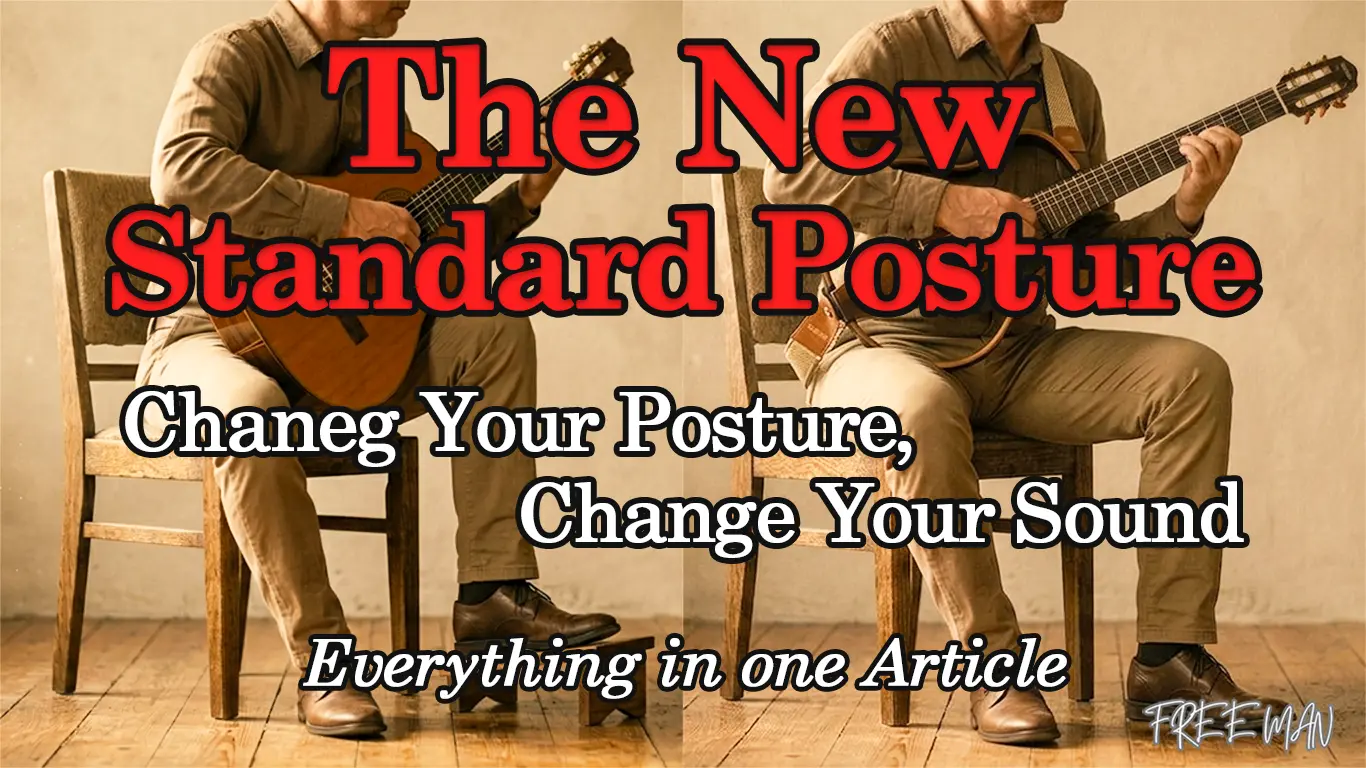
“Fix your posture, and your sound changes.” That’s not a motivational saying — it’s basic physics. And by leaning into what a silent guitar does differently, you can also cut way down on the physical toll, especially on your lower back.
Plenty of videos and articles already cover correct classical guitar posture in detail, so that ground is well covered elsewhere.
This article focuses on something more specific: a modern, practical “new standard posture” built around pairing a lightweight silent classical guitar with a strap.
Posture Comes Before Technique

Classical guitar has a playing posture that’s noticeably different from other guitar styles. Seeing it for the first time, some people assume it looks stiff or overly formal.
But this posture wasn’t refined for how it looks — it was refined to minimize physical strain while maximizing sound. Practice with the wrong posture for long enough, and it doesn’t just slow your progress; it builds up chronic strain in your shoulders, neck, and wrists. Getting it right from the start is what protects your ability to keep practicing long-term.
The Basics: 3 Keys to Playing With a Strap
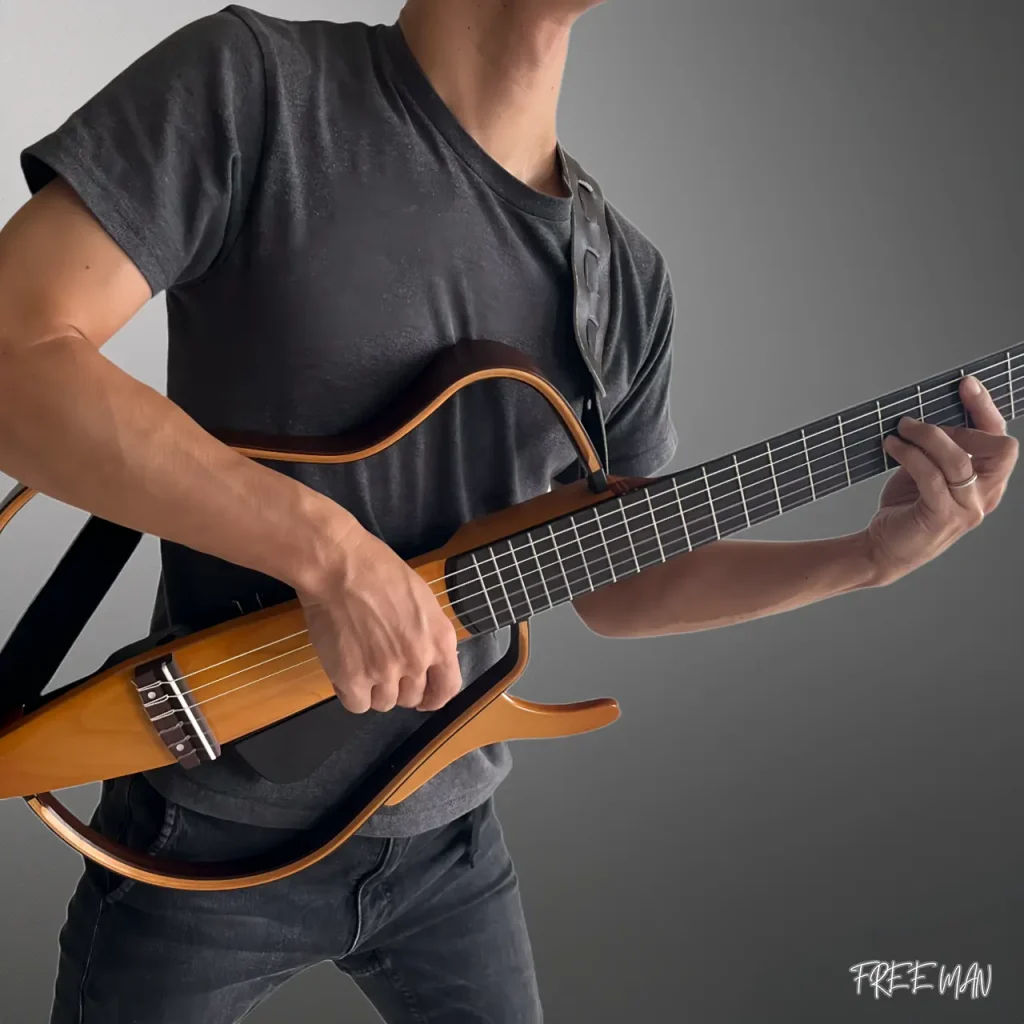
Key 1: Guitar Position and Stability (Strap Adjustment)
In traditional classical technique, the guitar rests on your left leg, with a footstool or guitar support pulling the body in close to you. The neck angles up and out at roughly 45 degrees, keeping the guitar stable as if it’s part of your body.
Once the guitar is stable, both hands are free. Only once you’re no longer spending effort just holding the instrument up can your left hand focus fully on fretting and your right hand focus fully on plucking.
All you need is a strap length that recreates that same ideal position. That’s genuinely it.
With a silent guitar and a strap, you don’t need a footstool or a special chair — you can play standing up if you’d rather.
Drop the footstool, put both feet flat on the floor. That alone helps prevent lower-back pain.
Because a silent guitar has no full body, it sits noticeably closer to you once strapped on, which lets you reproduce that classic “45-degree neck angle” without ever needing a footstool.
One important caveat: keep the guitar positioned relatively high. Don’t drop the strap down low the way electric guitar players do for style — that’s exactly what you want to avoid here!
Silent guitars have a thinner, lighter body than a standard classical guitar, which makes it noticeably easier to stabilize your posture. It’s a genuinely beginner-friendly design for anyone building correct posture from scratch.
Key 2: Right-Hand Position and Movement (Why a Thin Body Helps)
Let your right hand rest naturally over the strings, wrist gently curved, and pluck from there. Your elbow rests lightly on the guitar’s frame without locking in place; the sound comes from movement in your wrist and fingers. If you’re using a strap, there’s no need to rest the guitar on your knee at all.
Force the pluck, and the tone gets harsh and your wrist takes on more strain. Let gravity drop your finger into the string — that’s the feeling you’re going for.
The advantage of a silent guitar is its thin body. A guitar with real depth pushes your right shoulder outward and creates tension around your shoulder blade, whereas a silent guitar lets you hold your arm in a much more natural, relaxed position.
Key 3: Left-Hand Position and Staying Relaxed
Because the strap carries the guitar’s weight, your left hand is freed entirely from the job of holding the instrument up.
Rest your left thumb lightly on the back center of the neck, and press just behind the fret with your fingertips. The word “press” makes a lot of people grip too hard, but the actual force needed to bring a string into contact with the fret is surprisingly small. A light touch is genuinely enough.
That relaxation is exactly what makes fast phrases and difficult chord changes possible.
Get a free PDF practice blueprint that actually works in 15 minutes a day.
Just your email address — unsubscribe anytime.
Common Mistakes and How to Fix Them
Mistake 1: Holding the Guitar Too Low
Lengthen the strap too much, and your left wrist bends too sharply, which can lead to tendinitis over time. Keep the guitar at a height that actually suits classical playing.
Prioritizing “how it functions” over “how it looks” is the real key to enjoying this instrument for years.
I personally ended up gravitating toward fusion-style guitar playing, so I’ll admit I have a soft spot for holding the guitar higher and working it more actively — I just think it looks cooler that way (laughs).
Mistake 2: Hunching Forward
Craning your head forward to watch your hands puts a lot of load through your neck and shoulders.
Most shoulder tension and neck pain that shows up after long practice sessions traces back to exactly this posture issue.
Instead of lowering your gaze down to the guitar, think of it as bringing the guitar up into your natural field of view. Checking your side profile in a mirror is the fastest way to catch and correct this.
Mistake 3: Gripping Too Hard
It’s tempting to assume more force produces more volume, but on classical guitar, it’s the opposite. Relaxed fingers sink deeper into the string and produce a fuller, richer tone. Tension makes the sound harsh and gets in the way of fast passages. Start by releasing tension throughout your whole body — that’s the real foundation of classical guitar tone.

The Takeaway: Posture Is an Investment in Practice You Can Sustain
Spend your first week finding the posture and strap position that genuinely work for you, rather than rushing to memorize phrases. Once correct posture settles into your body, it becomes an asset you keep for life.
Use a modern tool like a silent guitar logically, without feeling bound by traditional technique. Being kind to your body ends up being exactly what dramatically raises your odds of sticking with guitar long-term.
This comes from years of personally pairing a silent guitar with a strap: not depending on chair height or worrying about strain on your lower back is a benefit you’ll feel very directly.
I can’t tell you how many hours I spent agonizing over chair height, footstool height, and how exactly to hold the guitar…