
You can play a piece with the score in front of you, but the moment you take the score away, you stop. Memorization is something many guitarists struggle with.
In this article, I explain how to memorize a piece not through rote effort but as a structured process, summarized as three tests (Point A–C).
This article is for classical and solo guitarists who share the following concerns.
- Players who want to be able to play guitar anytime, without needing a score
- Players who worry about their memory going blank in performance
3 Reasons Guitar Memorization Is Hard
Struggling with memorization is not a matter of practice time or talent. In most cases, the premise behind how you memorize is off.
Reason 1: Rote-Memorizing the Score Puts the Memory in the Wrong Place
When we think of memorization, we tend to picture burning the score into our heads.
But what actually sticks is not information held in your head. It is the movements your fingers have repeatedly traveled.
The harder you try to memorize consciously, the more your fingers suddenly stall, or you can’t recall the piece in performance. That happens because the place and the method of memorizing are wrong.
Reason 2: Solo Guitar Handles a Lot of Information at Once
Solo guitar involves a large amount of information at the same time.
- Melody
- Bass
- Harmony
One pair of hands covers all of it.
And even for the same note, you have to decide “which finger, on which string, and where to press.”
Unlike the memory used in jazz or rock, where you can rebuild a piece on the spot from a chord progression, each individual movement has to be stored in your body in a form you can reproduce exactly.
Reason 3: Believing “I Played It Through, So I Have It Memorized”
When you can play a piece straight through from the beginning, just as you practiced it, you tend to decide that you have memorized it.
But under the tension of a performance, the state of your body changes, and a memory that only lets you play straight through collapses easily.
- Can you start playing from the middle?
- Can you reproduce it with your fingers alone?
Not having checked these is the real cause of memory lapses.
Memorize Through Both the Structure of the Piece and the Movement of Your Fingers
Solo guitar memorization is made of two memories layered together.
- Memory of the structure of the piece (a map of how the melody, bass, and harmony move)
- Memory of the finger movements themselves (a state in which your fingers move without conscious thought)
Once you have both in place, you check that it has truly sunk in.
This process, turned into the three steps of Point A–C, is the “Memorization Algorithm” below.
Memorization Algorithm | The 3-Step Test: Point A–C
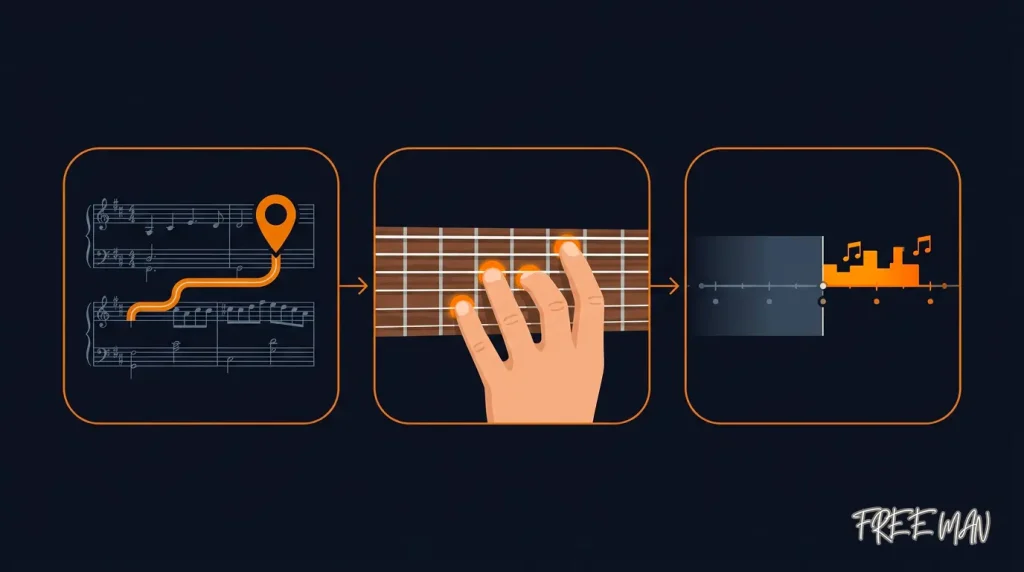
These are three tests that let you confirm guitar memorization through actions, without relying on feel or rote memorization.
Point A: Structure Test (Read the Map of the Piece)
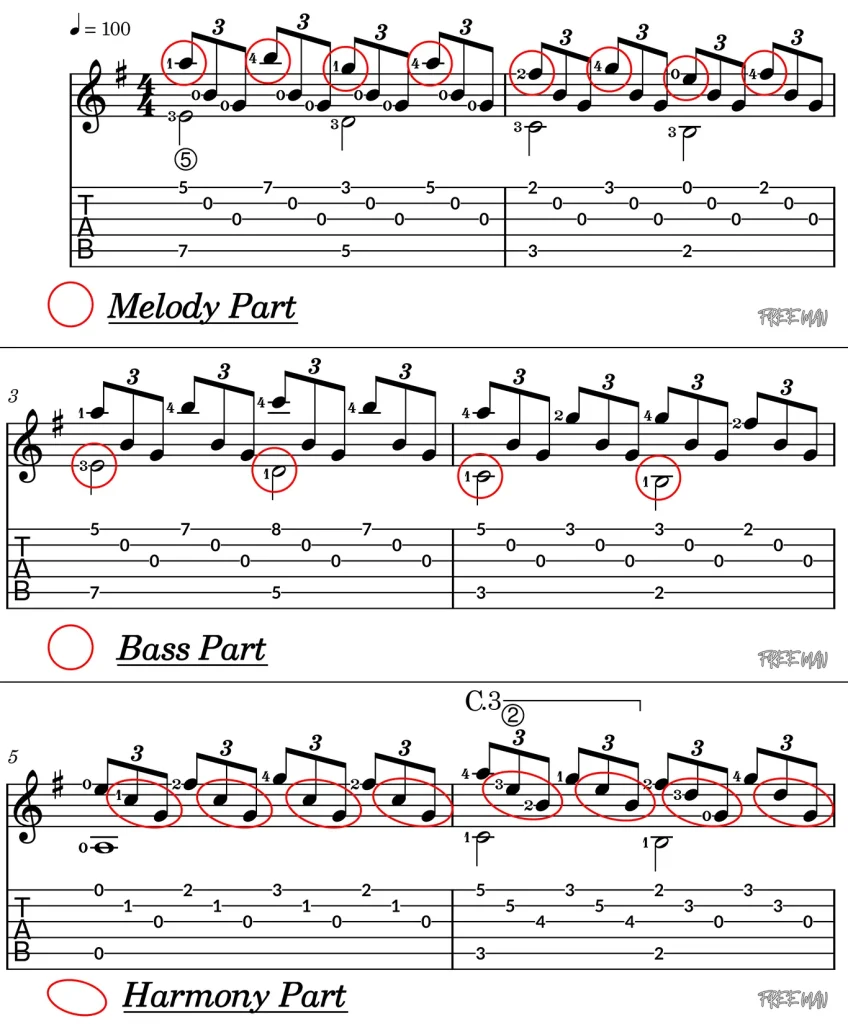
While looking at the score, check how the melody, bass, and harmony each move.
If you hold the map first, you can keep the places where you stumble from happening in the same spot every time.
Please check the image “Score sample for grasping the key points of the Memorization Algorithm”
You can read the melody part, the bass part, and the harmony part.
Point B: Motor Memory Test (Take Away the Score and Reproduce It With Your Fingers Alone)
After playing with the score, put it away once and play the same passage again.
Take note of where you stopped.
The places where you stopped are the places that have not yet entered your fingers. Check only those spots against the score again, then put the score away and play once more.
Point C: Resilience Test (Start Playing From the Middle of the Piece)
Start playing suddenly from a break in the piece.
Being able to play a guitar piece straight through from the beginning and being able to start from the middle are, in fact, completely different abilities.
Once you get through this, your memorization becomes a memory that is less likely to break down in performance.
Watch the Memorization Algorithm Demonstration on Video
Using the first 8 measures of the Memorization Algorithm, I demonstrate and explain Point A–C.
The score for the first 8 measures used here is also shown in the video.
The Second-Half Verification Section | Finishing With a Key Change and Tempo Change
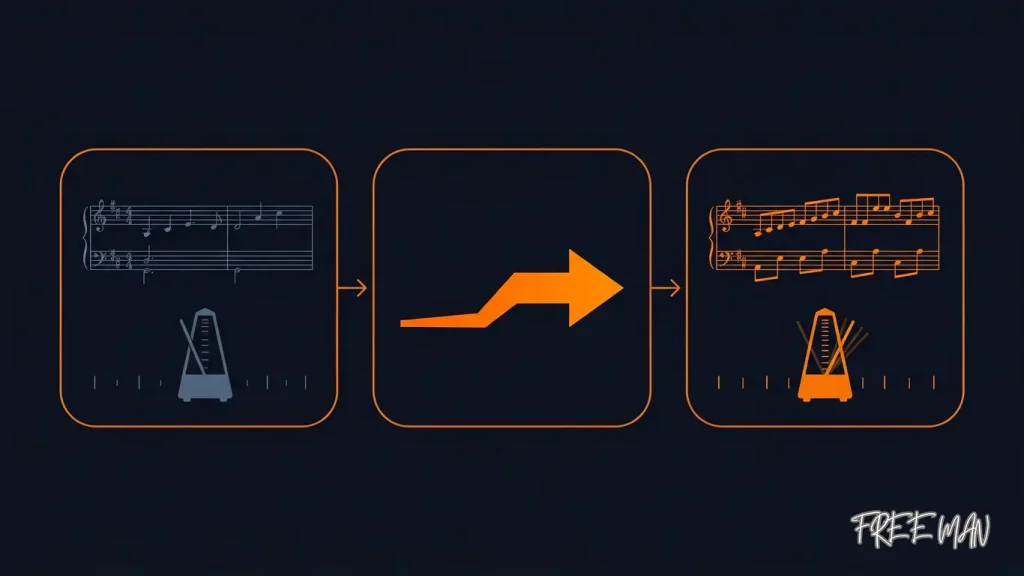
A procedure becomes your own only when it still works after the conditions change.
The second half of the Memorization Algorithm has a key change from Em to Gmaj and a tempo change, so it is more difficult than the first half.
You verify the Point A–C you learned in the first half in this second half, and make them your own through practice.
What the Memorization Algorithm Includes
- Full score of all 27 measures (first 8 measures / second 8 measures, including repeats) (PDF)
- Full-version demonstration video, including the second half (unlisted)
Who This Is For
- Players who stall when they take away the score
- Players who worry about their memory going blank in performance
- Players studying classical or solo guitar
Pricing, contents, subscriber-only perks, and more are listed on the dedicated email sign-up form.
Summary | Memorization Can Be Designed
Memorization is not a matter of talent or willpower. It can be built through a procedure.
- Read the structure of the piece
- Take away the score and reproduce it with your fingers alone
- Start playing from the middle of the piece
Passing these three tests in order is the shortest path to playing that holds up even without a score.
To make your guitar a lifelong companion, if you want to build everything systematically starting from the 15-minute practice blueprint, start here.