
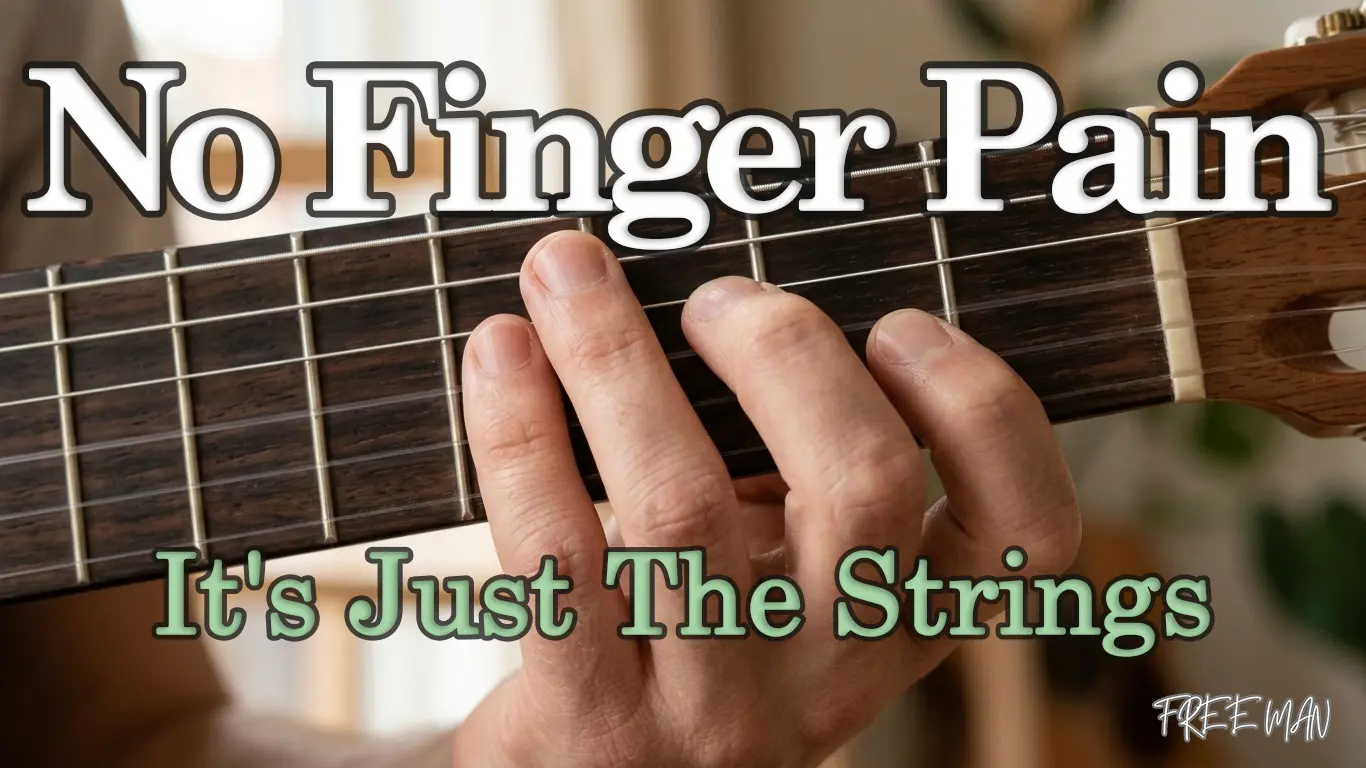
If finger pain made you quit, blame the strings — not the guitar.
Most People Who Quit Guitar Have This in Common
Your fingertips hurt every time you press down. The notes come out muffled. Your fingers turn red after every session. This isn’t a lack of willpower, and it isn’t a sign you’re “not cut out for it.” It’s the strings you’re using.
There Are 2 Types of Guitar Strings — And Most Beginners Don’t Know It
Steel Strings: Hard on Your Fingers
Most acoustic and electric guitars use steel strings. Because they’re metal, they’re stiff, and pressing them down takes real force. The majority of guitars marketed to beginners fall into this category — and that’s exactly where most “I couldn’t handle the finger pain” stories start.
Nylon Strings: Soft and Beginner-Friendly
Classical guitars use nylon strings. Compared to steel, nylon is noticeably softer — pressing down with the same amount of effort causes far less damage to your fingertips. You can practice pain-free starting from day one.
What Changes When You Switch to Nylon Strings
Change 1: You Can Play Again the Next Day
After a session on steel strings, your fingertips can be too sore to touch the next day. With nylon, you can pick the guitar back up and practice just as easily. Whether or not you can practice daily eventually becomes the gap in how fast you improve.
Change 2: You Focus on Sound, Not Pain
When you’re in pain, you can’t focus on the music. Once the pain is gone, your attention shifts from “how do I press this down” to “how do I want this to sound.” That shift changes the quality of your progress at a fundamental level.
Change 3: Practice Becomes Fun, Not a Chore
Practicing through pain just builds up negative associations with the guitar over time. Practicing without pain is simply enjoyable. Enjoyable means you keep going. Keep going, and you improve. That’s the correct order for building a habit that lasts.
Get a free PDF practice blueprint that actually works in 15 minutes a day.
Just your email address — unsubscribe anytime.
Why Nylon Strings Aren’t Recommended More Often
The market is dominated by steel-string guitars. Walk into most music stores, and the guitars labeled “for beginners” are almost always acoustic or electric. Classical guitars and nylon strings simply don’t cross your radar unless you go looking for them. You didn’t choose wrong — you just never saw the option.
The Takeaway: Changing Strings Changes Everything
If finger pain is why you quit, here’s the truth: you didn’t fail — you just had the wrong strings. Run the same practice routine on a nylon-string guitar, and the outcome changes. Sometimes the tool you choose is the difference between quitting and sticking with it. Guitar is a textbook example.
In the next article, we’ll look at a specific instrument that solves the noise problem and the finger pain problem at the same time.