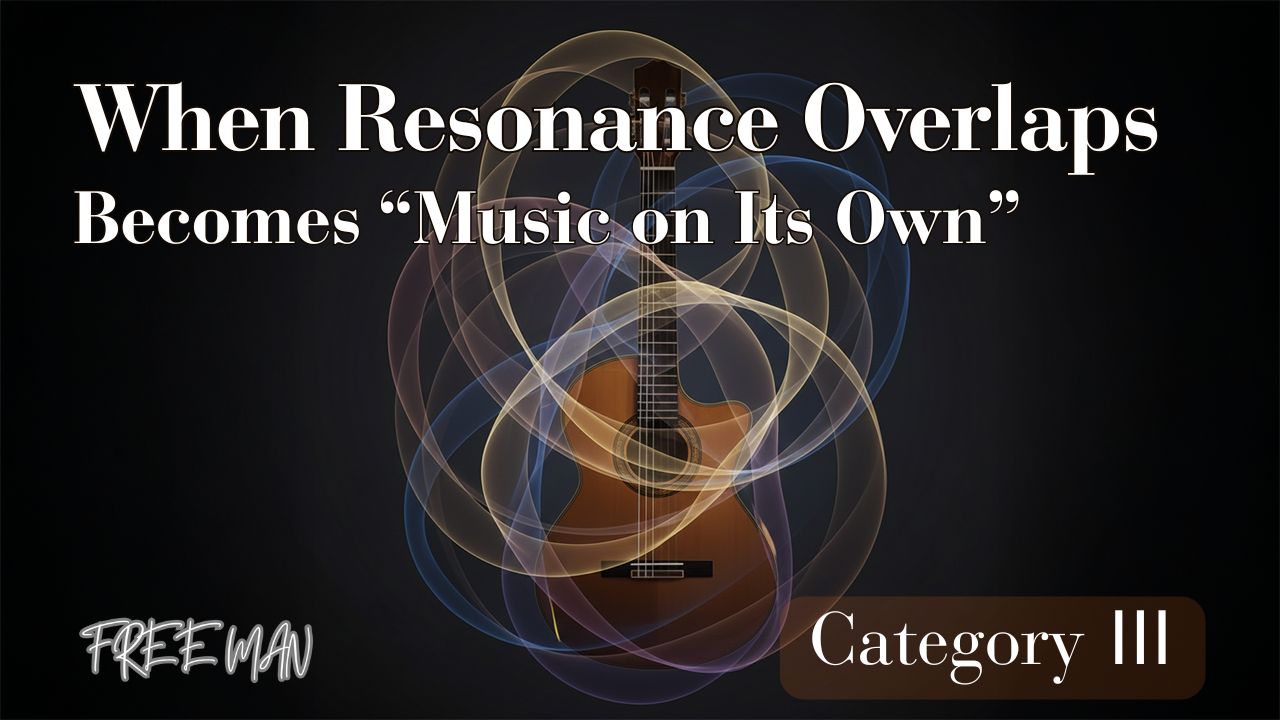
Music is perceived as music when harmony, bass, and melody overlap and coexist.
This is called polyphonic music, and the guitar is one of the rare instruments capable of performing true polyphony on its own.
Being able to make music anytime, anywhere, with just one instrument—
that is one of the guitar’s greatest strengths.
Category III: Polyphony, Harmony, and Musicality
At a certain point,
the guitar suddenly becomes a different instrument.
You were only playing single notes, yet
multiple sounds begin to exist at the same time.
The bass flows.
Harmony supports.
The melody sings.
Category III is a collection of works designed to let you experience
the exact moment when the guitar rises into “music.”
What Is Category III?
From Single-Line Playing to “Simultaneous Music”
In Category I,
your fingers learned to function correctly.
In Category II,
phrases gained flow.
But something is still missing if you want to truly play music on a single guitar.
That missing element is
the ability to consciously hear and control multiple voices at once.
In Category III, you clarify:
“How many voices are sounding right now?”
“Which note leads, and which notes support?”
The Core Themes of Category III
Resonance, Harmony, and Polyphonic Thinking
At the heart of Category III is a deep understanding of polyphonic structure—
handling melody, bass, and harmony simultaneously.
Bass Creates “Time”
- The bass line controls the pulse
- Musical forward motion is driven by the bass
Harmony Creates “Depth”
- Some notes inside a chord are subtle
- Yet they define the quality of the resonance
Melody Carries “Emotion”
- The singing voice
- Naturally rising without being buried by other parts
In Category III, you develop
the sensation of playing an ensemble by yourself.
What You Gain in Category III
Your Playing Shifts from Flat to Three-Dimensional
After passing through this category,
clear changes appear in your playing:
- Overlapping notes remain clear
- Chords truly resonate
- The melody naturally comes forward
As a result, listeners begin to say:
“It sounds professional.”
“That’s real classical guitar.”
“It feels like complete music with just one guitar.”
This is not about emotional expression.
It is the result of structural understanding.
Solo Guitar Works That Define Category III
All works in Category III are written with
polyphonic design as a foundation.
- Thumbnail image
- Piece title
- One-line role description
(Each score links directly to its individual Gumroad page.)
![[First Waltz] Beginner Etude in C](https://freeman365.net/wp-content/uploads/2026/02/19-3_First-Waltz-1024x576.jpg)
[First Waltz] Beginner Etude in C
“First Waltz”: Beginner etude for arpeggios and melody.
![[Gentle Breeze] Solo Etude in Am](https://freeman365.net/wp-content/uploads/2026/02/15-3_Gentle-Breeze-1024x576.jpg)
[Gentle Breeze] Solo Etude in Am
Cinematic, beginner-friendly solo with musical depth.
![[Bass & Two Voices] Solo Etude in Em](https://freeman365.net/wp-content/uploads/2026/02/23-3_Bass-Two-Voices-1024x576.jpg)
[Bass & Two Voices] Solo Etude in Em
Unique no-middle-finger (m) etude for all levels.
![[Expanding Voices] Mini Etude in Em](https://freeman365.net/wp-content/uploads/2026/02/6-3_Expanding-Voices-1024x576.jpg)
[Expanding Voices] Mini Etude in Em
Open-string etude for resonance and coordination.
![[Harmonic Flow] Mini Etude in C](https://freeman365.net/wp-content/uploads/2026/02/10-3_Harmonic-Flow-1024x576.jpg)
[Harmonic Flow] Mini Etude in C
C Major etude for chord resonance and voice leading.
![[Bass Harmony] Solo Etude in C](https://freeman365.net/wp-content/uploads/2026/02/21-3_Bass-Harmony--1024x576.jpg)
[Bass Harmony] Solo Etude in C
Master bass string control and RH independence.
Why “Healing” Is Completed in Category III
Soothing performances always contain space.
- Space between notes
- Time for resonance to linger
- Silence that waits for the next sound
Polyphonic playing naturally creates this space.
Without forcing emotion,
the structure itself becomes healing.
That is Category III.
Category III in the Learning Path
Category III represents
the completion point of musical intermediate playing.
- I → III
Fingers begin to support resonance - II → III
Flow rides on harmony - III → V
Advanced techniques become true music
Skip this stage, and advanced pieces will sound noisy rather than musical.
Who Category III Is For
- You feel your sound is thin
- Your chords sound muddy
- Playing alone feels unsatisfying
Category III exists to
fill your playing with music.
Summary: Category III Is the Boundary Where Sound Becomes Music
- Think in multiple voices
- Design resonance
- Make a solo guitar function as an ensemble
Beyond Category III,
what you play is no longer just practice sound—it is music.
👉 View All Categories
👉 Download Sheet Music on Gumroad
👉 Watch Full Performance on YouTube