— What Beginners Need to Know About Sound, and Why Classical Playing Does Work —
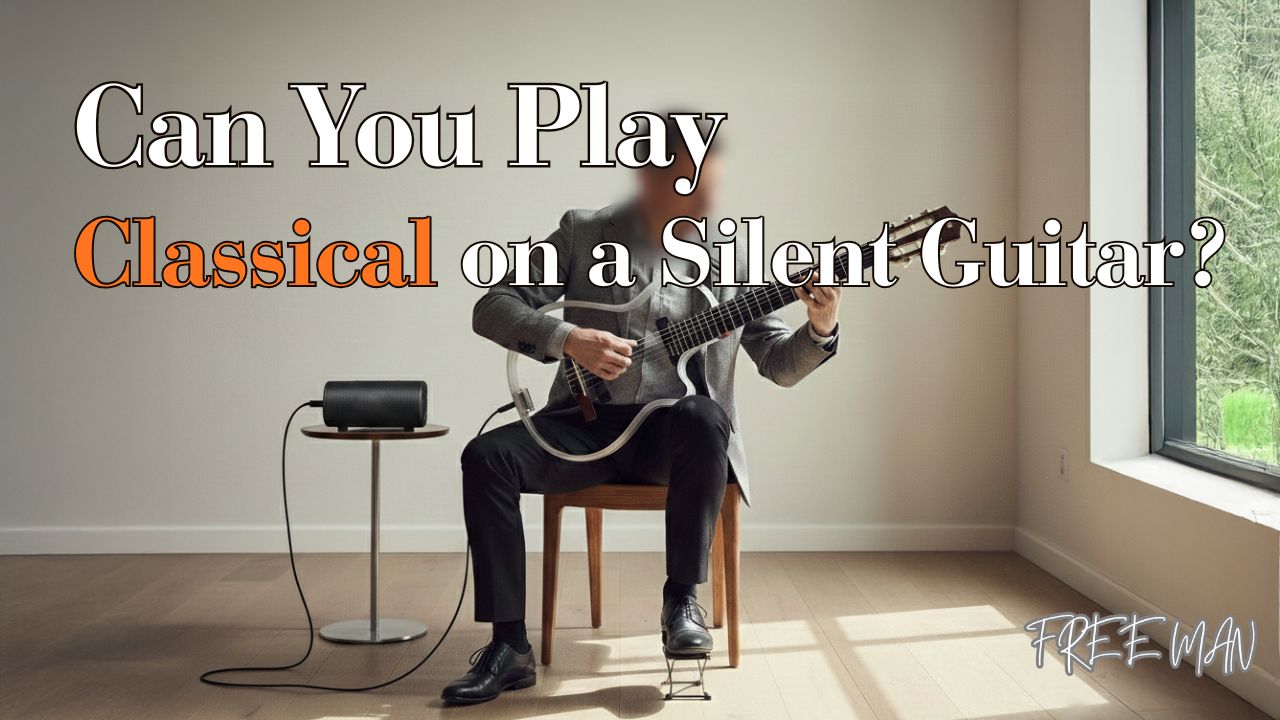
Many guitarists wonder whether it is really possible to play classical music on a silent guitar.
Beginners often feel this most strongly, but in reality, even experienced players share the same doubt.
- It feels different from an acoustic guitar
- The sound feels unnatural
- It doesn’t seem suitable for classical music
In this article, we focus on the relationship between silent guitars and classical guitar playing,
clarifying what causes these sound-related doubts and explaining why classical performance does work on a silent guitar.
Is a Silent Guitar a Substitute for a Classical Guitar?
Let’s begin by addressing the most fundamental question many players search for.
A Silent Guitar Is Not the Same Instrument as an Acoustic Guitar
A silent guitar is not simply a quieter version of an acoustic guitar.
- Acoustic guitar: the sound is completed by the body resonance
- Silent guitar: the sound is shaped at the output stage
The structure itself is fundamentally different.
If you try to play a silent guitar with exactly the same expectations as an acoustic guitar,
it is easy to feel that the sound is “not classical enough.”
Feeling That Classical Doesn’t Work Is Not Limited to Beginners
This discomfort is not exclusive to beginners.
Even experienced players encounter it.
The reason is simple:
most players are never taught where the sound is actually completed and what truly determines it.
A silent guitar is not an instrument that automatically becomes music when you play it.
It becomes music only after the sound is intentionally shaped.
That said, this does not require complex equipment or deep technical knowledge.
Important Notes When Buying a Silent Guitar for Classical Playing
If your goal is classical guitar performance, choose a model with a classical-sized neck.
For Yamaha silent guitars, this means selecting the SLG200NW model.
The “NW” version has a neck width and fingerboard spacing close to a classical guitar,
making it far easier to switch between silent and acoustic classical guitars.
Without this, the neck is too narrow and can seriously interfere with proper classical technique.
Where Does the Sound of a Silent Guitar Come From?
Now we arrive at the core of the topic.
The sound of a silent guitar is not determined by your playing alone.
When playing classical music in particular, three elements must be considered together:
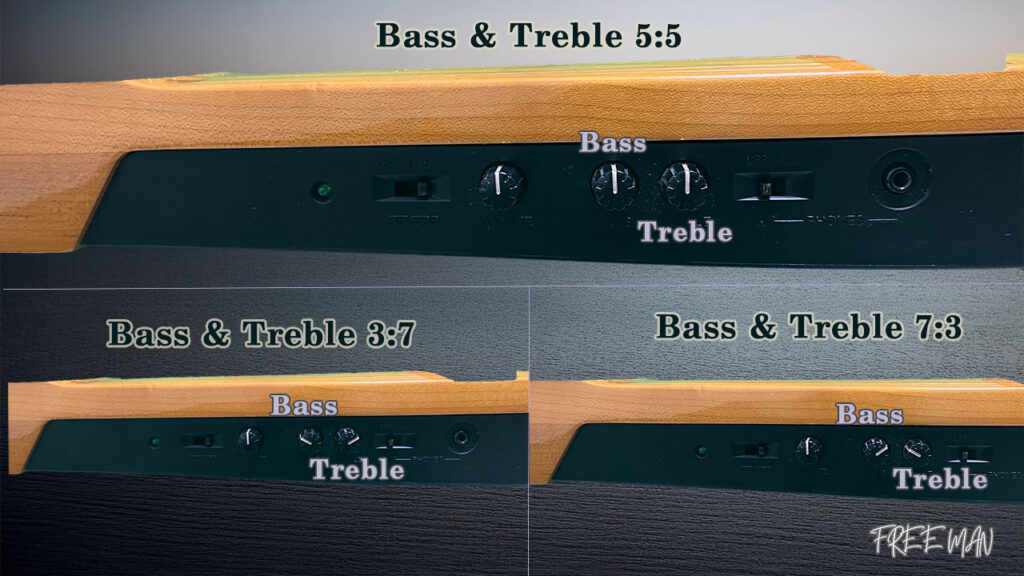
- The guitar’s onboard controls (Bass and Treble)
- The output device (speaker or headphones)
- The compatibility between sound setup and the piece being played
If even one of these is missing, the sound can feel unnatural
and lead to the conclusion that silent guitars are “not for classical music.”
How to Think About Bass and Treble Controls
- If the speaker emphasizes low frequencies
→ reduce Bass and slightly raise Treble - If the speaker emphasizes high frequencies
→ reduce Treble and slightly raise Bass
As a general rule, keep both controls within about one-third of their full range from center.
Start with both knobs centered, then adjust based on what you hear.
The Output Device Shapes the Entire Impression of the Sound
For silent guitars, a speaker is not just a playback device.
It plays the role that the guitar body plays in an acoustic instrument.
- Low-end support
- Harmonic spread
- How notes sustain and decay
All of these change depending on the speaker.
Affordable, portable speakers with stable sound quality are more than sufficient for classical practice.
One critical warning:
Avoid speakers with noticeable audio latency.
A silent guitar requires fast response to remain playable.
I personally use the Tribit XSound Go, which provides stable response and balanced sound.
About Using Headphones
Headphones are useful when you absolutely cannot make any external sound.
However, because the sound does not travel through physical space,
there is a clear limitation to how natural the tone can feel.
They are best used for late-night practice, fingering checks, or score reading—
not for final sound shaping.
High-powered guitar amplifiers are unnecessary for classical silent guitar playing
and often make delicate sound control more difficult.
Confirming the Potential of Silent Guitars Through Actual Performance
Rather than relying on theory alone, let’s look at real performance.
Even with the same silent guitar:
- An unadjusted setup
- A setup optimized for classical music
will produce completely different musical impressions.
Through actual classical solo performances,
you can hear that silent guitars can function as real musical instruments.
Silent Guitars Work for Players of All Levels
The value of a silent guitar goes far beyond being a “beginner practice tool.”
Just as there are expressions possible only on acoustic guitars,
there are strengths unique to silent guitars.
Silent guitars make it easy to understand:
- How sound is formed
- Where it changes
- How adjustments affect musical expression
They remove environmental restrictions,
increase playing frequency,
and allow sound design, expression, and musical completion to be treated as one continuous process.
This role changes as your level changes—but the value never disappears.
That is why silent guitars remain useful from beginner to advanced stages.
Silent Guitars as the Foundation of Classical Practice
Finally, let’s summarize.
With the Right Knowledge, Beginners Do Not Get Lost
Classical music is not impossible on a silent guitar.
What was missing was simply a shared understanding of how to think about sound and playing.
Deepening Classical Guitar Through Silent Guitars
On this blog and YouTube channel, I share:
- Sound design for silent guitars
- Real examples of classical guitar solo performance
- The Freeman Method, combining sheet music and structured practice
All designed to help you truly experience that
classical music can be played on a silent guitar.
For details on the Freeman Method (Beginner to Intermediate Graduation Course), please see the link.