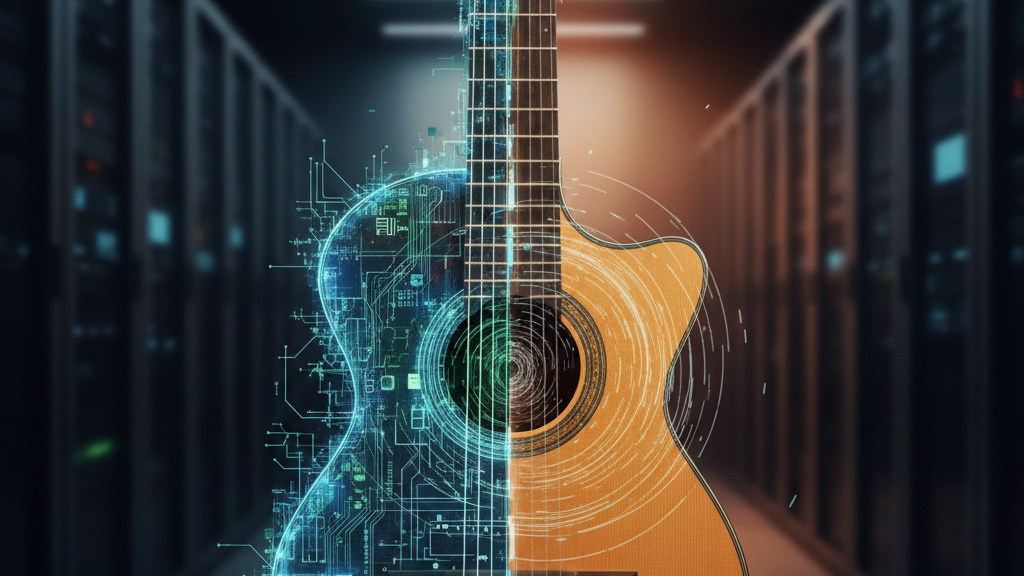
The age has arrived where AI can paint pictures, write novels, and even compose symphonies. In the realm called “creative,” are humans becoming unnecessary?
I posed an experimental question to the world’s highest-tier AI models: “Can you fully comprehend the characteristics of the classical guitar and compose and perform an emotionally moving piece using efficient fingering that is playable by a human?”
The answer was “No.”
AI can generate “data,” but it does not possess the “fingers” required to make a guitar sound. In this blog post, I will discuss the “Art of Fingering” and the “Truth of Performance” that only humans can create, precisely because technology continues to evolve.
AI Knows the “Theory” but Lacks the “Fingers”
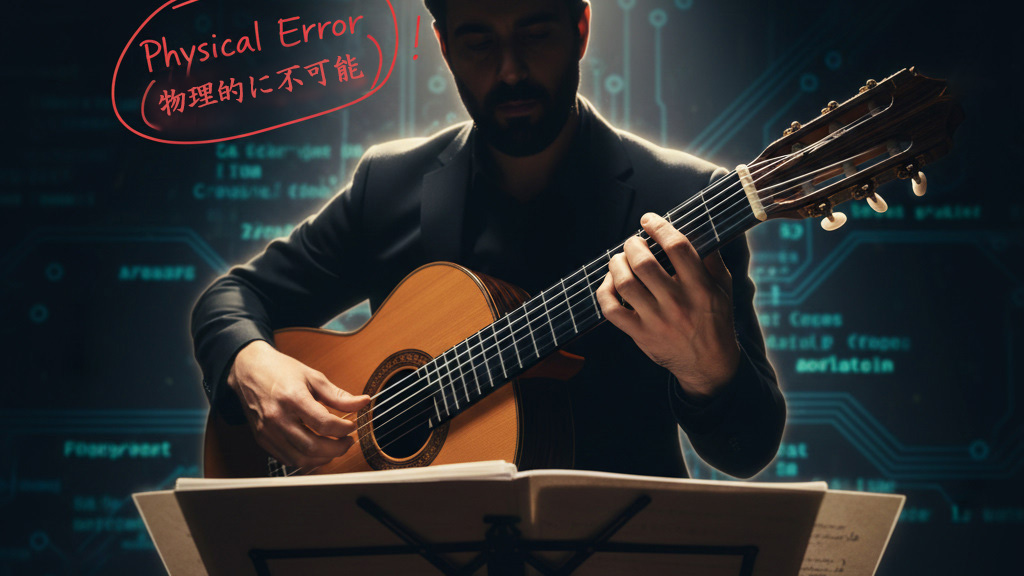
The Difference Between Calculationally Correct and Performatively Correct
If you ask an AI to “create a complex piece,” it will output a theoretically sound, intricate score in seconds. However, the moment a player attempts to play it on the guitar, many are left in despair.
This is because while AI knows the chord structure of C-E-G (C major), it does not know the “strain on the ring finger muscle of the left hand when pressing the 5th fret on the 3rd string and the 1st fret on the 2nd string” (both are the note C).
Scores written without regard for the physical distance on the fretboard, string tension, or finger size tend to be “impossible to play” or “inefficiently written, causing unnecessary stress to the player,” no matter how good the notes sound. Herein lies the “Wall of Corporeality” that data processing alone cannot overcome.
Human-Born “Magical Efficiency”
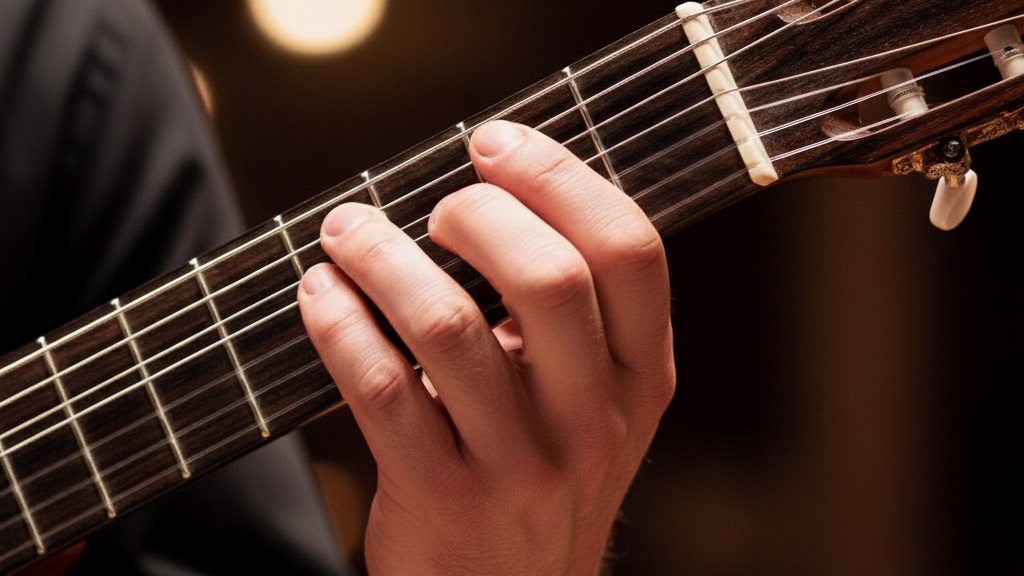
The Art of Sounding Complex but Being Easy to Play
What I pursue in my composition and performance is not mere difficulty. It is the experience of “sounding highly intricate and thrilling to the listener, yet surprisingly logical and easy for the performer.”
Specifically, I employ approaches such as:
- Utilization of Open Strings (e.g., Campanella Technique): Weaving together fretted notes and the resonance of open strings to produce a rich overtone texture with minimal effort.
- Optimization of Sextuplets and Right Hand (p-i-m): Artfully placing accents and melodies within a rhythmic right-hand pattern to sweep the listener into a vortex of “fast playing.”
“If I use an open string here, the left hand is freed up, allowing for an elegant shift to the next position.” Such judgments are the “Physical Wisdom” that can only be attained by a human who has deliberated and trialed thousands of hours on the fretboard. This “ergonomic beauty” that AI cannot fully calculate is the core of my work.
I presume that great historical instrumentalists and composers tirelessly conversed with their instruments and refined their methods through immense trial and error.
Video Proves the Weight of “Truth”
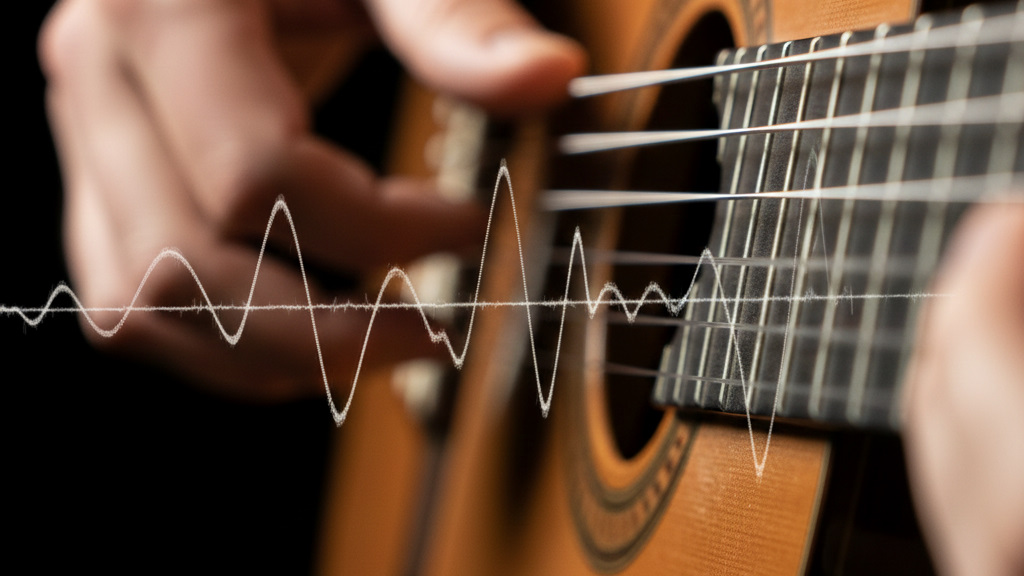
The “Millimeter of Reality” That Generative AI Video Cannot Depict
Currently, generative AI video can create “footage that looks like guitar playing.” However, it is difficult to fool a professional eye. The sound and finger movements might be slightly out of sync, or the chord shapes might be nonsensical.
The performance videos I release are not mere background music. They are proof that “this complex piece is actually playable by human hands through thoroughly calculated fingering.”
Precisely capturing a single string and a single fret to produce the intended tone, and the honesty in that continuous sequence of moments. The fact that “it is truly being played,” and the process of “how that difficult passage is conquered,” is what I believe becomes content that moves the hearts of both viewers and performers.
Conclusion: The Future of Human “Fingertips” Beyond Technology
While AI can be a wonderful partner, as long as the guitar remains a physical object, it is still the living human who can draw out its maximum potential.
“Solving complexity simply through wisdom.”
Is this not the value of the human guitarist in the age of AI? I will continue to pursue the new possibilities of the classical guitar through “optimal fingering” and “actual performance”—which only a human can achieve—while understanding the technological landscape.
Please take a look at my videos and scores. Within them lies a beautiful dialogue between the human and the instrument that AI has yet to reach.