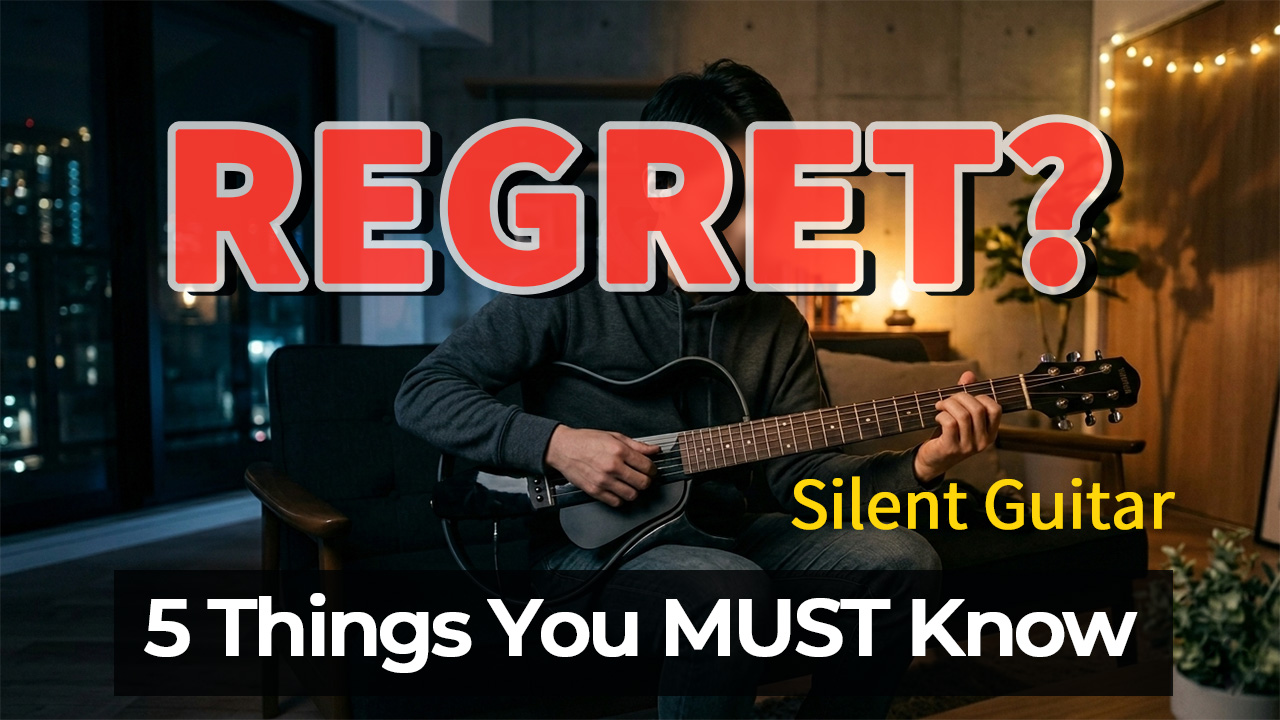
A silent guitar divides people into two groups:
those who regret buying it, and those who say it changed their life.
The difference is not the instrument itself.
In this article, I’ll break down:
- The typical reasons people regret buying a silent guitar
- The real weaknesses I discovered after completing 30 classical pieces
- The common traits of players who are glad they bought one
- How to choose without regret
No emotional bias. Just structural analysis.
If you read this before purchasing, you won’t make the wrong decision.
Conclusion: You Regret a Silent Guitar When Your Purpose Is Unclear
Let’s start with the truth.
People who regret buying a silent guitar usually:
- Prioritize acoustic resonance above everything
- Expect it to replace a traditional classical guitar
- Buy based on specs without trying one
On the other hand, regret drops dramatically if your goal is:
- Maximizing practice time
- Removing environmental limitations
- Practicing primarily with headphones or speakers
A silent guitar is not about “better.”
It is about “function.”
Reason #1: Expecting Acoustic Resonance
A silent guitar has no resonant body.
It cannot produce the natural air vibration of a wooden acoustic instrument.
If you buy one expecting traditional classical projection, disappointment is inevitable.
However, this is not a flaw — it is a design difference.
A silent guitar is built for amplified tone shaping.
Comparing it directly to an acoustic guitar misses the point.
Reason #2: The Feel Is Different Than Expected
Depending on the model, silent guitars vary in:
- Neck width
- String height
- Frame shape
- Weight distribution
Classical players switching from a full wooden body often notice the difference immediately.
Most regret comes from not testing the instrument beforehand.
If your goal is classical technique, choose a model with a traditional nut width (such as NW versions).
Skipping this step is one of the biggest buying mistakes.
Reason #3: Tone Shaping Requires Effort
An acoustic guitar produces a finished tone naturally.
A silent guitar depends on:
- Headphones
- Speakers or amplification
- EQ adjustments
- Reverb settings
If this feels like a hassle, the instrument may not be for you.
If you enjoy tone control and sound design, you will likely love it.
Especially when played through quality speakers, its expressive potential expands significantly.
Reason #4: Blaming the Instrument for Skill Gaps
A common claim:
“You can’t express emotion on a silent guitar.”
This is half true and half false.
Yes — natural air resonance and raw acoustic warmth belong to traditional guitars.
But:
- Touch sensitivity
- Right-hand control
- Dynamic variation
are absolutely trainable and performable on a silent guitar.
Expression limits are usually technical limits, not instrument limits.
Reason #5: Mismatch Between Use Case and Expectation
A silent guitar excels in:
- Night practice
- Apartment living
- Parenting households
- Frequent travel situations
It is arguably one of the most environment-adaptive instruments available.
However, if your primary goal is:
- Performing unamplified in a concert hall
- Recording exclusively with microphones
- Pursuing pure traditional classical aesthetics
then a wooden classical guitar is the better choice.
This is not a competition.
It is a question of fit.
Why I Personally Do Not Regret It
During a focused six-month silent-guitar-centered period,
I completed 30 classical solo pieces.
Not theory. Not speculation.
Execution.
The key question is not:
“Can you play it?”
The key question is:
“Can you complete music consistently?”
Removing environmental restrictions increases contact time.
And guitar improvement correlates strongly with contact time.
The player who touches the instrument more often wins.
Acoustic Guitar vs Silent Guitar: Which Should You Choose?
Choose an Acoustic Guitar If:
- Natural wood resonance is your top priority
- You want unamplified projection
- You value traditional instrument aesthetics
Choose a Silent Guitar If:
- You want to increase daily practice time
- You need to control volume
- Consistency matters more than projection
Neither is superior.
They are different tools.
Pre-Purchase Checklist
Before buying, ask yourself:
Pre-Purchase Checklist
Check 3 or more boxes to see “Good!”
If you answer “yes” to at least three,
the likelihood of regret drops significantly.
Final Verdict: Regret Depends on Usage, Not the Instrument
A silent guitar is not a universal solution.
But it breaks environmental barriers.
An expensive acoustic guitar means nothing if you cannot play it freely.
A silent guitar can drive growth —
if you use it intentionally.
In the end, the player who spends more time with the instrument progresses further.
Time beats tradition.
Silent Guitar Methodology: A Global Original.
A 30-Year Algorithm, Compressed into 3 Minutes.
A structurally designed 30-piece course system
built to help you perform expressive solo classical guitar as complete works — efficiently and methodically.